
In short
- The Panasonic Lumix G10 is from 2010: 12-megapixel Four Thirds sensor, 202,000-dot viewfinder, fixed 3-inch screen, and 720p video only in Motion JPEG.
- Used, it is worth around 100-180 euros with the 14-42 kit lens: above 200 euros it no longer makes sense, because for 350-360 euros you can get a Sony A6000 or a Canon EOS R100.
- The camera body has no stabilization: with almost all Olympus lenses, which lack optical stabilizers, you work without any stabilization and shutter speeds below 1/30 become a risk.
- It makes sense as an affordable body to enter the micro 4/3 system or as a lightweight second camera, not as the only camera for someone who wants to grow.
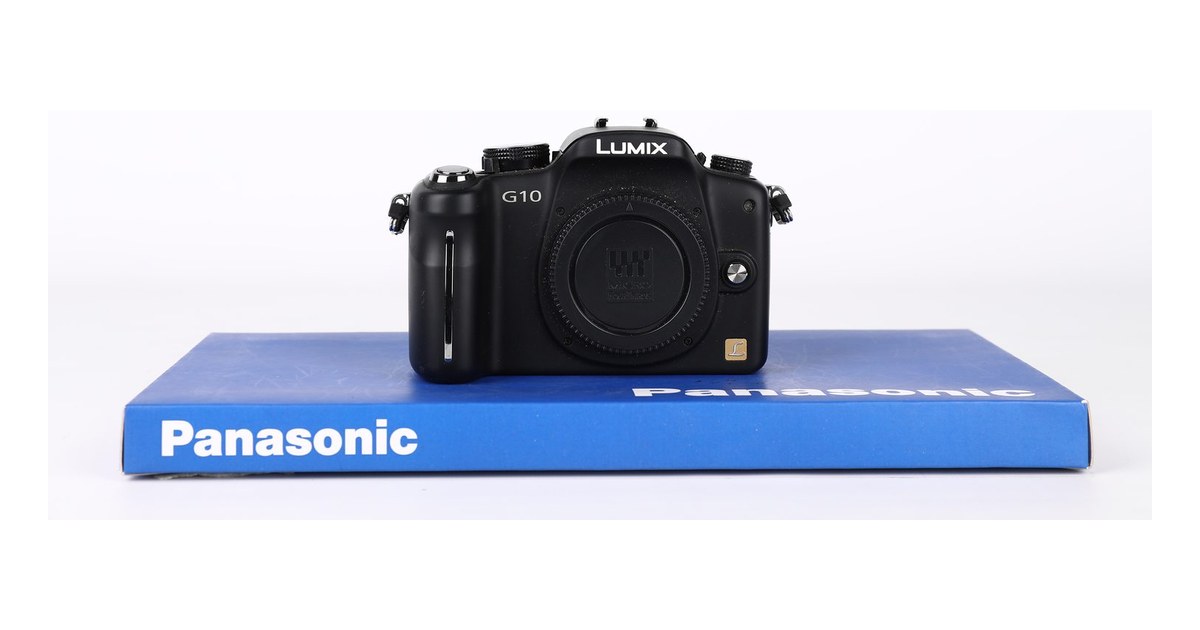
Every now and then, someone comes to the counter with a Lumix G10 in their backpack, bought ten years ago or inherited from a relative, asking whether it's worth keeping or if it's better to look for a used one as a first mirrorless. It's a legitimate question: it costs little, weighs less than 400 grams with the battery, and mounts all the micro 4/3 lenses released since then. But it's also a camera designed in 2010, and some of those choices weigh heavily today.
A quick clarification: many people search for “G10” meaning the Lumix G100, which is a completely different camera, and we discuss it in the first section.
What is the Lumix G10 and where does it fit in the Panasonic lineup
The Lumix G10 is the most affordable micro 4/3 mirrorless camera that Panasonic sold in 2010. Along with the G2, it replaced the 2008 G1: the G2 was the full-featured model, while the G10 was stripped down to the essentials to lower the price. The sensor is a 12.1-megapixel Live MOS Four Thirds with a 2x crop factor and ISO sensitivity of 100-6400. The mechanical shutter reaches 1/4000, and the electronic viewfinder is integrated into the camera body, a feature that many entry-level models no longer offer today.
G10 and G2: same base, different cuts
The sensor is the same as the G2, so at the same ISO, file quality is identical. The cuts affect everything around the sensor, and you can feel the difference in the field.
| Lumix G10 | Lumix G2 | |
|---|---|---|
| Sensor | 12.1 MP Four Thirds | 12.1 MP Four Thirds |
| Screen | 3", fixed, non-touch | 3", articulating, touch |
| Viewfinder | 202,000 dots | 1.44 million dots |
| Video | 720p Motion JPEG | 720p AVCHD Lite |
The heaviest cut is the viewfinder: the G2's panel has about seven times the dots of the G10's. Motion JPEG, at the same resolution, produces much heavier files than AVCHD Lite. If you find a G2 in excellent condition for just a few euros more, take a look: the sensor is the same, but the camera is better to use.
Be careful not to confuse it with the Lumix G100
At the counter, this happens often: a customer asks for the «G10» but means the G100, or vice versa. The names are almost identical, but ten years separate these two cameras.
- Lumix G10 (2010): 12.1 MP, 202,000-dot viewfinder, fixed screen, 720p video.
- Lumix G100 (2020): 20 MP, 4K video, 3.68-million-dot viewfinder, articulating screen designed for self-recording.
They only share the micro 4/3 mount, so lenses are interchangeable between the two without adapters. In every other respect, they are two different products for different people. If you are looking for a camera for vlogging or social media videos, you need the G100, not the G10. Buying the G10 because it costs less is not a saving: it costs less because it does not do what you need.
Before responding to a listing, check the model written on the camera body, as private sellers often confuse the two cameras in the titles. The G10 has the inscription on the front, below the Lumix logo.
What it still does well in 2026
With decent light and a stationary subject, a 2010 G10 takes photos that no one would recognize as old. The 12.1-megapixel Four Thirds sensor produces 4000 x 3000 pixel files. At 300 dpi, these are sufficient for an A4 print with a margin, and there is plenty of resolution for the web and social media. The JPEGs come out with typical Panasonic colors: natural skin tones, slightly desaturated greens, and reliable white balance in daylight. Many people use them directly, without going through a computer.
Then there's the ergonomics. The G10 has the shape of a small DSLR, with a real grip where your fingers rest. It can be held with one hand even with a lens a bit longer than the 14-42. Many compact mirrorless cameras today cannot do this. Finally, the mount: it is micro 4/3, so it fits all Panasonic, Olympus, and third-party lenses of the same system. We discuss this in the lenses section.
Image quality up to ISO 800
The sensor covers ISO 100-6400, but the usable range is much shorter. Here is how it works in practice:
- ISO 100-400: clean and detailed files, sufficient dynamic range for landscapes and portraits in natural light.
- ISO 800: still good. Noise is visible at 100% zoom, but not noticeable in A4 prints.
- ISO 1600: usable for the web or when converted to black and white, where grain is less distracting.
- ISO 3200-6400: fine detail disappears and colors fade. Best considered an emergency range.
The advice is to shoot in RAW. The G10's RW2 files open in Lightroom and Capture One. With modern noise reduction, you can recover about a third of a stop compared to the in-camera JPEG. It doesn't turn it into a low-light camera, but at ISO 800-1600, the difference is visible.
Autofocus: fast on stationary subjects, struggling with moving ones
The G10 focuses via contrast detection across 23 areas. The system reads directly from the sensor and therefore does not suffer from the front and back focus issues typical of DSLRs from that era. Once it locks on, focus is precise, even at full aperture. In single AF mode with the 14-42, it is fast.
- Great for: landscape, architecture, posed portraits, street photography with subjects walking slowly, travel photography.
- Struggles with: running children, dogs, sports, any subject approaching or moving away quickly.
The limitation lies in tracking. The AF-C is that of a 2010 camera: it struggles to track, loses the subject, and has to search for focus again. In low light, even single-point AF slows down and searches more. Those who mostly photograph stationary subjects will hardly notice. Those with small children or a dog will notice on the first day.
The real limits that a low price cannot erase
The G10 is affordable because Panasonic built it by removing components from the G2, and those omissions are still noticeable today. Before buying, it is advisable to understand them one by one. Some can be managed with a bit of method. Others remain fixed limitations of the camera.
- Fixed 3-inch screen with 460,000 dots: it does not tilt, so ground-level shots or shooting over a crowd are done blind. It is hard to read in full sunlight.
- Burst mode at 3.2 frames per second: a running child or a dog in the park cannot be tracked. You get one good shutter count out of ten.
- No Wi-Fi: to transfer photos to your phone, you need a computer or a card reader.
The viewfinder is the most obvious compromise
The electronic viewfinder has 202,000 dots, roughly one-seventh of the G2's. The image is small and grainy: it's fine for composing, but not for judging sharpness. With manual focus, you have to rely on the screen magnification, as it's impossible to tell if the focus is correct through the viewfinder. If you move your eye or the camera, red, green, and blue fringes appear: this is the rainbow effect typical of this type of panel. Some people don't notice it, while others get a headache after half an hour. Those coming from a Canon EOS 600D or a Nikon D3200, with their optical viewfinders, will find it uncomfortable from day one.
No in-body stabilization: what it means with lenses
The G10 sensor is not stabilized, so everything depends on the lens mounted. The kit 14-42, the 45-200, and the 14-140 Lumix have optical image stabilization (OIS), so the issue does not arise with them. Almost all Olympus lenses (the few exceptions have the IS designation in the name, such as the 12-100mm f/4 IS PRO) and many fast primes, like the Lumix 20mm f/1.7, are not stabilized. With these lenses, the practical rule is to use a shutter speed of at least 1/(2 × focal length), because on Micro 4/3 the equivalent focal length is doubled:
| Non-stabilized lens | Recommended minimum shutter speed |
|---|---|
| 20mm f/1.7 | 1/40 – 1/50 |
| 25mm | 1/50 – 1/60 |
| 45mm | 1/100 |
At home, in the evening, this means raising the ISO. On a 12 MP sensor from 2010, noise is already visible in A4 prints above 1600 ISO.
Video is an extra, not a reason to buy
The G10 records at a maximum of 1280x720 at 30p in Motion JPEG. It is a low-compression format: files weigh significantly more than an AVCHD or H.264 of the same duration and quickly fill up a 16 GB card. There is no external microphone input, so audio comes from the internal microphone and also picks up lens noise. It is fine for recording your daughter's dance recital. For YouTube or professional work, in 2026, no: anyone wanting to shoot video must choose a different camera.
How much does it cost used, and when does it stop being worth it
A Lumix G10 today costs less than a good camera bag, and the right price depends almost entirely on what's included in the box. The camera body alone is worth little: it's the lenses that make the difference. That's why it makes sense to think in terms of configuration, not just model.
Realistic price ranges
These are the figures we see circulating in the second-hand market among private sellers and shops, for working units with no obvious defects:
| Configuration | Indicative price | Note |
|---|---|---|
| Body only | 70-120 euros | Only makes sense if you already have Micro 4/3 lenses |
| Body + 14-42 kit lens | 100-180 euros | The most common configuration |
| Body + 14-42 + Panasonic 20mm f/1.7 | up to 250-280 euros | The 20mm alone is worth more than the body |
Read the last line carefully. Sellers of the kit with the 20mm f/1.7 charge more for the lens, not the camera. It is a sensible purchase because the 20mm remains valid on the next micro 4/3 camera body you will buy. The kit 14-42, however, adds little value: it is an honest lens, but it can be found everywhere for just a few dozen euros.
Under €100 with the 14-42, be wary of listings without sensor photos or battery information. Over €180, without the 20mm in the box, you are overpaying.
The 200 euro threshold
Above €200 for the body and the 14-42, the G10 stops being a good deal. Not because it’s a bad camera, but because with another €150-200 you move up a product category. The two alternatives we have in store today, with a 2-year warranty:
- Sony A6000 at 360 euros: 24 MP APS-C sensor, hybrid phase-detection autofocus, burst up to 11 fps. It is from 2014, but on moving subjects it plays in a different league.
- Canon EOS R100 from 350 to 400 euros: 24 MP APS-C, Dual Pixel AF with face recognition, RF mount. It is from 2023, thirteen years younger than the G10, and opens the door to a fully active system.
The math is simple. At 200 euros, the G10 is a 2010 camera body that you will likely need to replace soon if photography becomes a serious hobby. At 350-360 euros, you buy a camera that can accompany you for years, already serviced and covered by warranty. If your budget is fixed at 150 euros, the G10 makes sense. If you can reach 350, those 200 euros spent on the Panasonic risk becoming an expensive intermediate step.
What to check before buying one
A G10 from a private seller for 120 euros becomes a useless expense if, after a week, you have to buy a battery and sensor cleaning. These are checks that take ten minutes, with the camera in hand and your own SD card. If the seller won't let you do them, walk away.
Battery and power supply
The original DMW-BLB13 was rated for approximately 380 shutter counts according to the CIPA standard. After 10-15 years, many only last half as long, and some discharge suddenly even when the indicator still shows two bars. Ask to take some test shots for a few minutes with both the viewfinder and screen turned on, and watch how quickly the charge drops. Lumix cameras from that generation reject certain compatible batteries. If you plan to use a non-original battery, test it on the camera before paying.
Sensor, viewfinder and screen
- Stop down to f/16 and photograph a uniform sky or a light-colored wall. Then zoom in on the file on your computer, not on the camera's screen: that's where you'll see dust and spots.
- Set a black and a white background and check the screen and viewfinder for dead or stuck pixels.
- Switch between the screen and the viewfinder several times and verify that the change works every time, without jams or black screens.
- Turn the diopter adjustment all the way to the end on both sides: it must move without any dead spots.
Shutter and certified shutter count
On Lumix cameras of that generation, the shutter count cannot be read as simply and reliably as on Canon models. Be wary of anyone who gives you a precise number without explaining how they obtained it. The shutter is assessed based on its behavior:
- a burst of 15-20 shutter count without hesitation or lag;
- a 1-second exposure and a 1/4000s exposure on a uniform scene, to check if the brightness matches the intermediate shutter speeds;
- the 1/4000s files zoomed in at 100%, looking for dark bands on one side: these are the typical sign of tired shutters.
What we do in our workshop
Every Micro 4/3 camera body that comes to us goes through the same protocol. We clean the sensor and test the shutter at all speeds, not just the most commonly used ones. Then we check the dials, mount, and electrical contacts. We test autofocus with a reference lens, so a defect in the body is not confused with one in the lens. A camera that does not pass is not put up for sale, even if it costs little. On a body worth 150 euros, a repair costs more than the camera, so we reject it.
Micro 4/3 lenses to pair with the G10
On a G10 paid 120 euros, the lens changes the photos more than any other purchase. It is also the part of the expense that is not lost. In two years, the camera body will be worth very little, while a good micro 4/3 lens resells close to the price paid.
The 14-42 kit lens: keep it or replace it
The Lumix G Vario 14-42 f/3.5-5.6 Mega OIS covers a 28-84mm equivalent and features optical image stabilization. On a body without stabilization, this matters more than it might seem. At f/8, it is honestly sharp and has no major flaws. The limitation is the aperture: at 42mm, it drops to f/5.6, and in dim indoor lighting, the G10 must push to 1600-3200 ISO, where the 2010 sensor already shows noticeable noise. Keep it as a utility zoom. Replacing it with another budget zoom will not improve your results.
The 20mm f/1.7 pancake: the classic pairing
The Lumix G 20mm f/1.7 ASPH is equivalent to a 40mm and is an ultra-thin pancake lens. Mounted on the G10, it transforms the camera into a fixed-lens street compact. Compared to the 14-42, it gains more than two stops of aperture, allowing you to work with much lower ISO settings in the same light conditions. There are two limitations. The autofocus is slow and noisy, especially in the first version, and the lens is not stabilized. On the G10, this means shooting without any assistance, but at 40mm equivalent, 1/60s remains a shutter speed that is manageable handheld.
Lenses that are also worth it on the next body
With the G10, it makes sense to invest in lenses and upgrade the camera body later. These two lenses remain useful even after the upgrade:
| Lens | Equivalent | Stabilized | Indicative Used Price | Best For |
|---|---|---|---|---|
| Olympus M.Zuiko 45mm f/1.8 | 90mm | No | 130-180 € | Portrait, bokeh |
| Lumix G Vario 14-140 Mega OIS | 28-280mm | Yes, optical | 200-350 € | Travel with a single lens |
On the G10, the 45mm is the most delicate case. At 90mm equivalent and without stabilization, you need at least 1/125 to be safe, which is not guaranteed indoors with artificial light. The 14-140 has its own stabilizer and is the only sensible all-rounder for this camera body. When you move to a stabilized body like the Panasonic Lumix G80, the 45mm will finally be stabilized by the body, and you can use it even at 1/30.
The spending order we recommend: first the 20mm, then the 45mm. Get the 14-140 only if you travel and want to carry a single lens.
Alternatives: other Micro 4/3 and today's entry-level mirrorless cameras
If your budget reaches 300 euros, the G10 is no longer the most sensible choice. There are three paths. The right one depends on what you want to keep: the lightweight lenses of Micro 4/3, a more modern APS-C sensor, or full frame.
Sticking with Micro 4/3: Olympus E-M10 or Lumix G80
The Olympus E-M10 solves the heaviest limitation of the G10 because it features in-body stabilization. Every lens mounted becomes stabilized, including Olympus primes and adapted manual lenses. Additionally, the sensor increases to 16 MP and the screen becomes tiltable. The Lumix G80, on the other hand, is the complete step up: a much larger and sharper viewfinder, 4K video, a weather-sealed body, and stabilization that works in conjunction with Panasonic lens stabilization. We have laid out the differences between the two in the comparison between used Olympus E-M10 and Lumix G80.
Mirrorless APS-C entry level from 350 to 500 euros
If you are not committed to Micro 4/3, this price range offers 24 MP camera bodies, which is double the pixel count of the G10 on a larger sensor. Here are the three models we have in store today:
| Model | Price | Key Strength |
|---|---|---|
| Sony A6000 | 360 euros | Phase-detection autofocus and 11 fps burst rate: ideal for sports, children, and animals |
| Canon EOS R100 | 350–400 euros | RF mount, the system Canon is investing in, and simple menus for beginners |
| Sony ZV-E10 | 500 euros | Microphone input and articulating screen, designed for video, but without a viewfinder |
For photography, the A6000 remains the most versatile. Released in 2014, it tracks moving subjects much better than the contrast autofocus of the G10. The ZV-E10 only makes sense if video is truly a priority, as the lack of a viewfinder is noticeable in stills.
Full frame at the same price as a good Micro 4/3
A Sony A7 for 350 euros costs the same as a G10 with a couple of fast primes. For that price, you get a 24x36 sensor with 24 MP. Noise at high ISOs is lower and bokeh is easier to achieve, at levels that Four Thirds cannot reach. However, the compromises must be stated. The camera body is heavier and bulkier and is not stabilized. NP-FW50 batteries have a short lifespan, so at least two spares are needed. Full-frame lenses cost more than micro 4/3 lenses. If you are looking for lightness, stick with micro 4/3. If, for the same budget, you are looking for image quality for landscape and portrait, the A7 is the most solid choice.
Who the Lumix G10 is for and who it isn't
The G10 is a good camera for those who already know what they will do with it. It is a poor purchase for those hoping it will do everything. At the counter, we recommend it in two specific cases and advise against it in almost all others. The criterion is almost always the budget, combined with what you want to photograph in the coming years.
When we recommend it
The most sensible case is for those who already own a more recent Micro 4/3 and are looking for a second camera body to keep in their bag. For someone using a Lumix G80 as their main camera, a G10 body for around 80 euros serves as a backup with a second lens already mounted. The lenses are the same, but the batteries are not: the G10 uses the DMW-BLB13, while the G80 uses the DMW-BLC12, so two chargers are required. If it drops or gets wet, the loss remains small.
The second profile is the beginner with a strict budget cap. For less than 150 euros, they can take home a complete kit with the 14-42 and learn to use manual controls, exposure, and depth of field. If the passion grows, the lenses purchased in the meantime transfer to the next camera body without losing value.
- Yes: for those who already own Micro 4/3 lenses, those looking for a lightweight second camera under 150 euros, and those who want to try the system with minimal spending.
- No: for video shooters, those photographing sports, running children, or animals, those finding it for more than 200 euros, and those coming from a DSLR who expect a comfortable viewfinder.
When we recommend spending more
If you are buying a single camera and plan to keep it for five years, the G10 is not the right choice: after a few months, those who outgrow it will find its limitations, sell it, and buy again, resulting in a total cost that exceeds what would have been spent on the right choice made from the start. With double the budget, you can move up to the Canon EOS R100 at 350 euros or the Sony A6000 at 360 euros, both with a 2-year warranty and serviced by our workshop.
If you haven't decided between mirrorless and DSLR, and are perhaps drawn to a true optical viewfinder, you can find a comparison with the most common DSLR alternative in the article on the used Nikon D5600.
Frequently asked questions
Are the Lumix G10 and the Lumix G100 the same camera?
No. The G10 is from 2010, features 12 MP, a 202,000-dot viewfinder, and 720p video. The G100 is from 2020, offers 20 MP, 4K video, and a tilting screen, and is designed for vlogging. They only share the micro 4/3 mount.
What is the current value of a used Lumix G10?
Approximately 70-120 euros for the camera body alone, and 100-180 euros with the 14-42 kit lens, depending on condition and accessories. Above 200 euros, it is advisable to look for a more recent mirrorless camera.
Do Olympus lenses work on the Lumix G10?
Yes, the Micro 4/3 mount is common to both Panasonic and Olympus. The limitation is stabilization: almost all Olympus lenses do not have it, and the G10 does not have it in the body, so with those lenses you shoot without stabilization.
Is the Lumix G10 good for video?
Only for occasional clips. Records at 1280x720 at 30p in Motion JPEG, with large file sizes, mono audio, and no microphone input. For videos, you need a G80, a G100, or a Sony ZV-E10.
Can I find out the shutter count of a Lumix G10?
On Lumix cameras of that generation, the shutter count cannot be read as simply and reliably as on Canon models. We assess the overall condition and perform a shutter test across all shutter speeds, which is the procedure we follow in our lab.
Which is better: a used Lumix G10 or an Olympus E-M10?
The E-M10 is newer and features in-body image stabilization, which stabilizes any lens mounted to it. If the price difference is 50-80 euros, the E-M10 is the most sensible purchase.
Looking for a used Micro 4/3 or entry-level mirrorless? Let's talk
If you have questions about a purchase or need advice for your specific case, contact us. We offer free advice because we are photographers first and sellers second, and because a customer who makes a poor purchase does not return to photography.
Three ways to get in touch:
- Contact form — response within 24 business hours
- WhatsApp at 342 362 3454 (messages only)
- Phone: 071 291 6347 (Mon-Fri 9-13/15-18, Sat 9-13)
And if you want to see what we have in stock right away, explore the used items available today: every camera is certified, comes with a 2-year warranty, and is shipped within 24-48 hours.
Article written by Matteo for the ReflexMania Team. Last updated: November 2026. Prices and availability as of the date of publication.