
In short
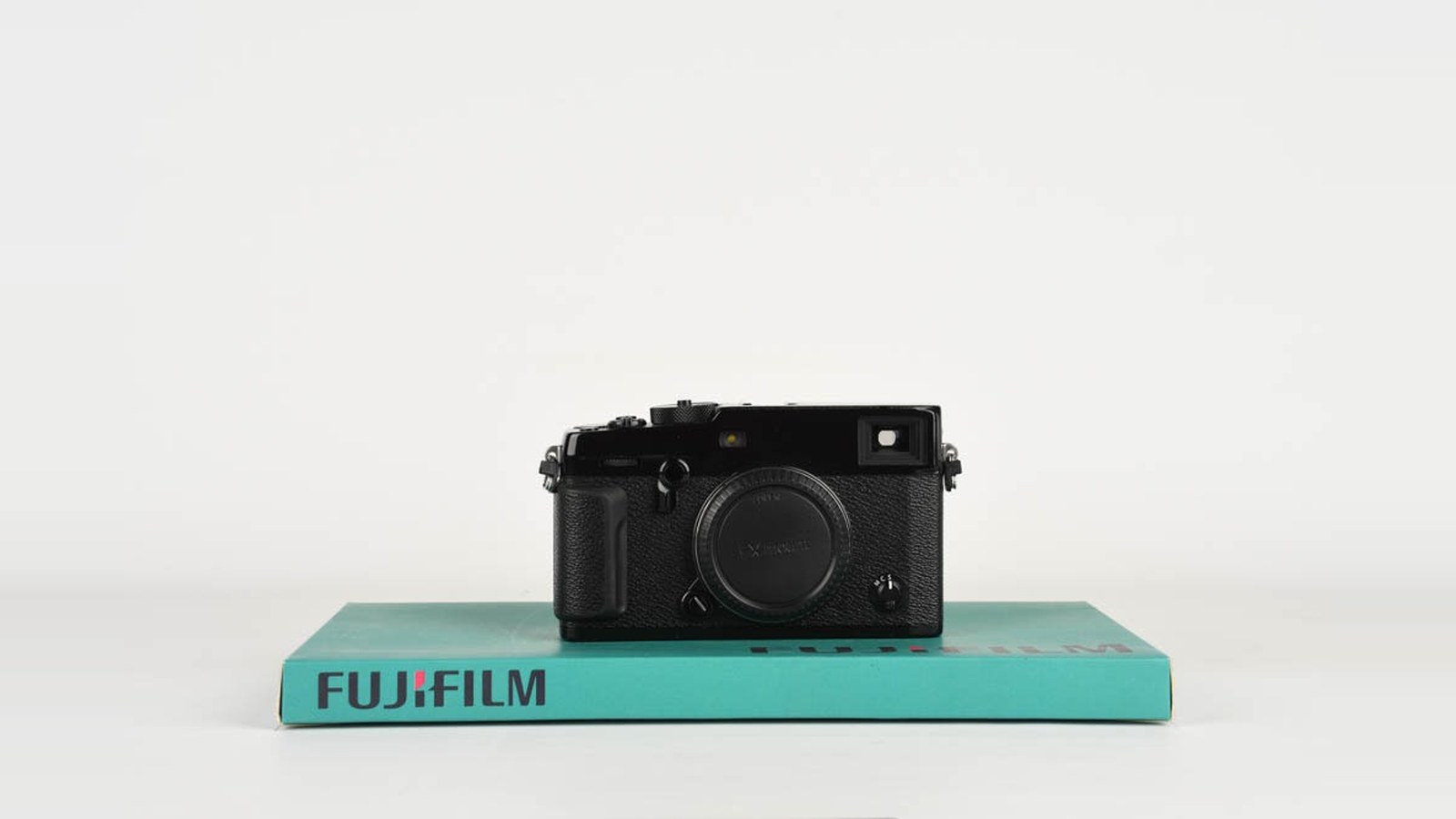
- The X-Pro3 features the same 26.1 MP X-Trans IV sensor and the same X-Processor 4 as the X-T3. You are paying for the hybrid viewfinder and the titanium body, not for image quality.
- The first point to check is the hidden screen that flips 180°: the hinge and flat cable work with every opening, and the 1.28" sub-monitor must light up uniformly.
- The mechanical shutter is rated for 150,000 cycles. A unit with fewer than 20,000 shutter count has almost its entire useful life ahead, but the number must be read from the metadata and not taken at face value.
- In 2026, a used X-Pro3 in excellent condition costs between 1,300 and 1,700 euros, which is more than it was worth at the end of production. An X-T3 with the same sensor can be found today for 800 euros.
Looking for a used Fujifilm X-Pro 3? The used Fujifilm X-Pro 3 page shows current availability and prices, with certified shutter count and a 2-year warranty. See also all used Fujifilm cameras.
The first X-Pro3 I opened at the counter had 4,000 certified shutter count and a screen that no longer sat flush in its housing: the customer had been carrying it in a bag without dividers, half-open. It is a camera you either love or hate, and those who buy it have usually already decided with their heart. That is precisely why it is easy to buy it poorly: you look at the titanium, you try the optical viewfinder, and you forget to check what actually breaks.
In this article, you will find the points we verify in our lab for every X-Pro3 that comes in, in the order we check them, distinguishing between what matters and what is purely cosmetic. I also explain its current value and for whom it makes sense and for whom it does not: if you shoot video, use long telephoto lenses, or review every shutter count on the screen, there are better and more affordable options.
Why the X-Pro3 is a camera apart (and who it isn't for)
The X-Pro3 is built around a precise idea. You view the scene through a viewfinder located in the left corner of the camera body, while the screen remains closed against the back. Shutter speeds, sensitivity, and exposure compensation are adjusted via physical dials. On paper, it is a fourth-generation Fujifilm: 26.1 MP X-Trans IV, no in-body stabilization, weather-sealed body, dual UHS-I SD card slots, and 4K video up to 30p. The rest of the technical specifications matter little. This camera is bought for how it is used.
The same sensor as the X-T3, an opposite experience
The sensor and processor are the same as those in the Fujifilm X-T3, which we currently have in stock for 800 euros. With identical optics and settings, the RAW files from both cameras are equivalent: same dynamic range, same noise at high ISOs. For JPEGs, the X-Pro3 offers the Classic Neg simulation, which the X-T3 lacks. Anyone who thinks the X-Pro3 produces better files is mistaken. The extra cost goes into the hybrid viewfinder, the camera body, and the user experience.
Fujifilm introduced the X-Pro3 as a return to «pure photography». In practice, this means the camera removes the temptation to review every shutter count. It is an ergonomics choice, not a file quality issue. For some, it truly changes the way they shoot. For many others, it becomes annoying after a week. Before spending almost twice as much as an X-T3, it is worth understanding which of the two groups you belong to.
Who should skip it
There are profiles for which the X-Pro3 is simply the wrong camera, at any price:
- Video shooters. With the screen that flips downward, framing is not comfortable on a tripod or gimbal, and there is no in-body image stabilization. The X-T3 records 4K up to 60p and costs much less.
- Users of zooms beyond 90 mm. A flat body with a telephoto lens attached is unbalanced, and the optical viewfinder is not useful beyond medium focal lengths. For wildlife and sports, a camera with a deep grip is a different story.
- Those who need in-body image stabilization. With fast prime lenses and low light, you are left working only with shutter speed. If this is a requirement, the X-Pro3 does not meet it.
- Those who want the screen always visible. Those who check the histogram and focus after every shutter count, or often shoot from low and high angles, find themselves constantly opening and closing the screen.
If you identify with any of these points, the X-Pro3 is not an ambitious purchase but a misallocation of funds. For the same amount, you can buy a more suitable camera body and still have budget left for a good lens.
The hybrid viewfinder: OVF, EVF, and electronic rangefinder
The hybrid viewfinder is the reason you buy an X-Pro3 instead of an X-T3, so it needs to be tested more carefully than any other part. Compared to the X-Pro2, Fujifilm changed one detail that matters. The X-Pro2's optical viewfinder had two magnifications, 0.36x and 0.60x, while the X-Pro3 has a single fixed magnification of 0.52x. It is designed for focal lengths between approximately 23 and 50 mm. With a wider-angle lens, the frames end up close to the edges, making the optical viewfinder uncomfortable. With a long telephoto lens, the frame shrinks to the size of a postage stamp.
Switch lever and electronic rangefinder
The front lever has two functions. Pushed to one side, it switches between the optical and electronic viewfinders; pushed to the other, it activates the ERF, the small electronic window in the bottom right corner of the optical viewfinder. The lever is spring-loaded: after each movement, it must return to the center on its own, without stopping halfway or exhibiting any lateral play. When switching to the EVF, a small click is felt, which is normal: it is the internal shutter closing the optical path.
- Focus frames: in OVF mode, they must be sharp, well-contrasted, and free of dark areas.
- Parallax correction: focus on a subject at 50 cm and then on one at infinity. The frame should shift and resize. If it remains stationary, there is an issue with the communication between the lens and the camera body.
- ERF: it must appear in the corner, magnify the focus area, and update without visible stuttering.
Dust and haze in the optical viewfinder
The optical viewfinder has its own path, separate from the sensor, featuring multiple lenses and a prism. Dust that enters there cannot be removed with a blower. To check for it, point the camera at a light bulb or a bright window and look inside with your eye slightly off-axis. Specks on the front window can be cleaned in a minute. However, distinct dots that remain stationary when you move the camera, or a uniform milky haze, indicate internal contamination. In that case, partial disassembly in a lab is required, and the cost should be factored into the negotiation.
3.69 million-dot OLED EVF
The electronic viewfinder is a 3.69-million-dot OLED. It should be tested under two different conditions, as defects do not appear in the same way.
- In the dark or with the lens cap on: the black must be uniform, with no hot pixels or brighter areas at the edges.
- Against a blurred white wall: dead pixels, color casts, and shadows of icons imprinted after years of use become visible.
- In bright light: the eye sensor must turn on the EVF as soon as you bring your eye close and turn it off as soon as you move away, with no delays or random activations.
An eye sensor that activates on its own due to side sunlight usually has a dirty window, which can be resolved by cleaning it. Burned pixels in the OLED, however, mean the panel needs to be replaced.
The hidden screen: the weak point to check first
At the counter, issues with a used X-Pro3 usually stem from the screen opening downwards more often than from the sensor or the shutter. Fujifilm hid it to force you to look through the viewfinder. The price is a hinge and a flat cable that bend with every opening, always at the same point. Anyone shooting with the camera held low opens and closes it dozens of times on every outing.
Just keep the camera on in shooting mode, and the full test takes two minutes:
- Open and close the screen 10-15 times while viewing the live image.
- Stop it halfway and then at 180°, ensuring it stays where you leave it.
- Close it and check the rear sub-monitor.
- Reopen it and touch the four corners, the edges, and the center.
Hinge and flat cable
Throughout the entire movement, the image must remain stable. A flicker, a colored line, or a momentary blackout at a specific point in the travel path indicates a worn-out flat cable. Today it is an intermittent defect, but over time it can turn into a black screen. When closing, the shutter must be crisp. If the screen remains lifted by a millimeter or reopens on its own, the hinge has lost its grip. With the screen open, simply move it laterally with two fingers: any perceptible play is a sign not to be ignored.
The 1.28-inch sub-monitor
With the screen closed, a small low-power display remains visible on the back. It can show the set film simulation, much like the card from the box that was inserted into the back of film cameras, or the shooting parameters. The contrast must be uniform across the entire surface, with no lighter bands, dead zones, or incomplete characters. You should switch the display mode via the menu to check both modes, as a defect may appear in only one of them. Photos remain identical even with a faulty sub-monitor, but the defect must still be factored into the price.
Fingerprints and scratches on the glass
On the X-Pro3, the touch function is used to move the focus point and scroll through images. Dead zones almost always appear along the edges and in the corners, rarely in the center, so it is advisable to check there carefully. When the screen is closed, the glass remains protected, meaning scratches reveal how the camera was used: left open for long periods, placed face down, or put in a bag without closing it. A scratch on the central area is visible every time you frame from below. A mark on the titanium, however, is purely aesthetic, which is why the screen glass matters more.
Titanium body and DR finishes: what is aesthetic and what is a problem
The top and bottom plates of the X-Pro3 are made of titanium, which changes how the camera ages. With this body, you need to determine whether a mark affects only the finish, has reached the metal, or indicates a drop.
Black vs. Duratect: How They Age
The standard Black model is painted. After heavy use, the underlying light titanium appears on the edges of the caps and the rims of the dials. Many consider this a pleasant patina. However, if the certified shutter count is low and the edges are worn, something is off. The DR Black and DR Silver models feature the Duratect surface treatment, which resists everyday scratches much better. The DR Black retains fingerprints and smudges that may look like signs of use at first glance, but they can be removed with a cloth. A scratch that has penetrated the Duratect, on the other hand, cannot be touched up. On the used market, DR models cost approximately 100-150 euros more than the Black model in equivalent condition.
Dents and drop marks
Titanium deforms very little, so a genuine dent on a top plate indicates a strong impact, almost always on an edge. Often, the damage occurs in the bag, with the camera body hitting a lens without a divider in between. We discuss this in the article on what to check in a used photography bag. The dent should be assessed together with the mount, as that is where the impact is absorbed.
- Mount a lens and move it gently: it should have no play or creaking.
- Inspect the mount with raking light: all screws must be present and the flange must not be deformed.
- Photograph a flat wall at full aperture, with the camera parallel to the subject, and compare the four enlarged corners.
If the corners are uniform, the dent is cosmetic and only affects the price. If the same side remains softer even after changing the lens, the mount is no longer true, and the body must be thoroughly inspected before purchase.
Dials, hatches, and seals
The shutter speed dial also features the ISO setting: to use it, lift the edge and rotate it. It must lift effortlessly, return to its position on its own, and have a crisp click at every value. The same check applies to the exposure compensation dial and the joystick, which must respond in every direction and to central pressure. The battery, card, and port doors must close flush, with no raised rubber seals. The 70-point weather sealing only protects if every gasket is in place. A door that doesn't close must be factored into the price before payment, not discovered in the first rain.
Shutter count, shutter and sensor: the numbers to check
On a X-Pro3, the shutter count does not appear in any menu. If someone tells you the number verbally or writes it in the listing, they are providing a figure they have no way to prove. The only data that matters is what can be read in the metadata of a file taken at that very moment, in front of you.
How to read the shutter count on a Fujifilm
Fujifilm saves the shutter count in the EXIF maker notes, which is the part of the metadata reserved for the manufacturer. You take a JPEG, copy the file to your computer, and open it with exiftool: the field to look for is Image Count. The file must be new, taken with that card during the test. If they send you an old or already processed file, the data tells you nothing about the camera you are about to buy.
Keep in mind that this number counts images, not mechanical shutter cycles. The electronic shutter does not move the curtains and therefore does not wear them out. A camera used extensively in electronic mode, for example for silent work, may show a high count while the mechanical shutter remains barely used. The reverse, however, does not happen: the number never underestimates wear. Therefore, it should be read as a maximum limit, along with the overall condition of the camera body. The complete procedure, valid for other brands as well, is in our list of 12 checks for a used mirrorless.
How many shutter count is too many on a X-Pro3
The mechanical shutter is rated for 150,000 cycles. This is a design average, not a guarantee: some units arrive and exceed this limit, while others fail earlier. The ranges we use to assess a unit are as follows:
| Shutter count | Reading |
|---|---|
| Under 20,000 | Lightly used, nearly full lifespan remaining |
| 20,000 – 60,000 | Normal enthusiast use, no issues |
| 60,000 – 80,000 | Heavy use, requires closer inspection |
| Over 80,000 | Price must reflect this |
To make the numbers work, you need a benchmark. In service, shutter replacement costs around 300 euros for parts and labor. If a X-Pro3 with 90,000 shutter count costs only 100 euros less than one with 15,000, the discount doesn't cover the risk.
Sensor and firmware
Two shutter counts are enough for the sensor:
- Spots: f/16 against a uniform sky or a white wall, slightly out of focus. Zoom in to 100% and check the corners. Dust can be removed with a cleaning, whereas a scratch on the filter in front of the sensor remains.
- Hot pixels: 30-second exposure at ISO 160 with the lens cap on and long exposure noise reduction disabled. A few isolated points are normal and can be corrected with pixel mapping. If there are dozens or clusters, the camera body should be rejected.
- Banding: in the same dark file, raise the shadows in post-production and look for regular horizontal or vertical lines.
Finally, check the firmware version in the menu and compare it with the latest one published on the Fujifilm website. If it is not up to date, perform the update before paying: it must complete without errors or abnormal reboots.
How much is a used X-Pro3 worth in 2026 and when it’s not worth it
Today, a used X-Pro3 costs more than it did in the final years of its production run. This is not because the camera has improved. The market around it has changed, and buyers need to know how much of that price they are paying for the camera and how much for the trend.
| Version and condition | Indicative price 2026 |
|---|---|
| Black, several signs of use, over 50,000 shutter count | €1,300–1,400 |
| Black, excellent condition, under 20,000 shutter count | €1,450–1,550 |
| DR Black or DR Silver, excellent condition | €1,550–1,700 |
Why prices have risen after production ended
There are three reasons, and none of them relate to image quality. The first is its discontinuation in 2023: since then, the supply has been used only, and it decreases every month. The second is the X-Pro4, which everyone was waiting for but which never came out. So, anyone looking for an optical viewfinder on a Fujifilm interchangeable lens camera has only this camera or the previous X-Pro models.
The third is the X100V effect. The compact has become a social media object, it has been unobtainable for months, and a portion of that demand has shifted to its interchangeable lens sister. Those buying for street photography have driven up the price even for those who simply want to take photos. If a unit exceeds 1,700 euros without accessories or exceptional condition, you are paying for the hype.
X-T3 at half the price: what you're really missing
With the Fujifilm X-T3 at 800 euros, the RAW files are the same, as we have seen. The 500-900 euro difference buys you these features:
- What you lose with the X-T3: the hybrid optical viewfinder, the hidden screen, and the titanium body.
- What you gain: a three-axis tilting screen, a more pronounced grip, and internal 4K 60p 10-bit video, whereas the X-Pro3 tops out at 30p.
If you always keep your eye on the EVF or compose on the screen, the X-Pro3 makes no sense: you are paying for a viewfinder you will not use. The X-T3 does the same job and leaves you with 700 euros for a lens like the XF 23 mm f/2 or the XF 35 mm f/1.4.
There is a second case where it is not worth it. If your limitations are low light or depth of field, at this price point you can find a full frame. A used Sony A7 III costs less than a X-Pro3 and offers in-body stabilization and about one stop less noise. What to check before buying it can be found in our guide to the used Sony A7 III. The X-Pro3 is only justified if the optical viewfinder is the reason you are buying it.
Telemetry-style alternatives for a lower budget
With the two Sony models, ranging from 360 to 550 euros, you get the form factor of the X-Pro3: a flat body, the viewfinder in the left corner, your right eye at the viewfinder and your nose free from the screen. However, you cannot buy the experience at that price. None of the cameras listed below have an optical viewfinder, and none have the shutter speed and ISO dials that make the Fujifilm so direct to use.
| Model | Catalog Price | Viewfinder | Key Feature |
|---|---|---|---|
| Sony A6100 | €550 | Electronic, left corner | Autofocus with tracking and eye AF |
| Sony A6000 | €360 | Electronic, left corner | The most affordable way to get the rangefinder form factor |
| Olympus PEN E-PL6 | €250 | None | Fits in a jacket pocket with a pancake lens |
Sony A6100 and A6000: the most affordable rangefinder-style body
The Sony A6100 at 550 euros features a 24 MP APS-C sensor and a 425-point phase-detection autofocus with real-time tracking. This matters for street photography: the subject crossing the frame stays in focus without manually moving the focus point. The touch screen tilts 180° upwards, which helps with low-angle shots.
The Sony A6000 at 360 euros is the entry point. It features 179 phase-detection AF points and a non-touch screen. However, with good light and slow-moving subjects, it still performs well. Compared to the X-Pro3, both models lack:
- optical viewfinder and illuminated frames: there is only a small EVF, adequate but far from the Fujifilm one;
- dedicated dials: shutter speeds and ISO are set via generic dials and customizable buttons;
- weather sealing: protection is required in the rain;
- battery life: the NP-FW50 battery lasts a short time, and at least two spares are needed for a day out.
Olympus PEN E-PL6: pocket mirrorless under 300 euros
The Olympus PEN E-PL6 at 250 euros should be considered separately. There is no viewfinder: you compose on the rear tilting screen, at arm's length. The 16 MP Micro 4/3 sensor has a 2x crop factor, so a 17 mm lens frames the scene like a 34 mm on full frame. It features in-body stabilization, which the X-Pro3 lacks, and it is quite discreet on the street.
It only makes sense as a pocket camera for those who want to find out if street photography is for them before spending €1,300. If you already know you want to shoot with your eye to the viewfinder, the E-PL6 is not for you.
The advice we give at the counter is simple. If you are looking for the X-Pro3 for its hybrid viewfinder, none of these cameras can replace it, and it is better to wait until you have the budget rather than buying a compromise. If, however, you are mainly interested in a flat and discreet body, the A6100 at 550 euros does almost everything you need, and with the difference you can buy two good lenses.
What we do in the lab on a X-Pro3
Every X-Pro3 that reaches our bench undergoes the same checks, in the same order, before being added to the catalog. On this model, half of the work focuses on two components that do not exist on other Fujifilm cameras: the hidden screen and the optical viewfinder. The rest is the standard review we perform on any mirrorless camera, adapted to the weak points of this specific body.
The point-by-point checklist
This is the complete sequence. The last column matters more than the others, as it indicates when we do not list a unit for sale.
| What we check | How | What makes us reject the unit |
|---|---|---|
| Shutter count | Reading EXIF maker notes from a file taken at the counter, never from the seller's data | Unreadable number or discrepancy with wear on dials and caps |
| Hinge and flat cable | Dozens of full 180° openings with the screen on, monitoring the image throughout the entire range of motion | Flickering, lines, or shutdown even once |
| 1.28" sub-monitor | Powering on in all display modes, checking uniformity | Darker areas or dead segments |
| Optical viewfinder | External cleaning, backlit inspection of the optical assembly, verification of the illuminated frames | Dust or haze inside the assembly, misaligned frames |
| Sensor | Wet cleaning, shots at f/16 on a uniform background and long exposures with the body cap mounted | Spots remaining after cleaning, an abnormal number of hot pixels |
| Mount | Contacts, screws, play with a reference lens, autofocus test | Mechanical play, oxidized contacts, communication errors |
| Firmware | Update to the latest version released by Fujifilm | None: it is updated and that's it |
| Dials, levers and doors | Every dial in every position, ISO pop-up, OVF/EVF lever, joystick, door closure and seals | Dial skipping positions, door not staying closed |
If a component can be replaced without compromising the rest, we replace it. If the issue lies in the optical viewfinder assembly, the camera body is not put up for sale.
Why the 2-year warranty matters on this camera
The screen's flat cable bends with every opening, and material fatigue is not visible in a ten-minute test. A perfect unit today may start to flicker after six or twelve months of daily use. No bench check, whether by us or a private seller, can rule this out with certainty.
For this reason, a private seller asking for 150 euros less is not making a deal for you. If the flat fails in the seventh month, the out-of-warranty repair eats up that difference, and the camera body stays in service for weeks. With 2-year warranty, that risk passes to us.
If the hidden screen doesn't interest you much and you're looking for the X-Trans IV sensor performance, the Fujifilm X-T3 we have for 800 euros undergoes the same inspection and comes with the same warranty. On top of that, it features a traditional tilting screen, which is much less exposed to wear.
Frequently asked questions
Does the X-Pro3 have better image quality than the X-T3?
No. They mount the same 26.1 MP X-Trans IV sensor and the same X-Processor 4, so the RAW files are equivalent. For JPEGs, the X-Pro3 adds the Classic Neg simulation. The real difference lies in the hybrid viewfinder, the hidden screen, and the titanium body.
Does the hidden screen break easily?
It does not break easily, but it is the most exposed component. The hinge and flat cable work with every opening and suffer if the camera travels in a bag with the screen half-open. It must be tested with 10-15 opening cycles before purchase.
How do I read the shutter count of a Fujifilm X-Pro3?
The data does not appear in the menus. It is extracted from the EXIF maker notes of a JPEG just taken, for example using exiftool. A number stated verbally by the seller has no value if it is not verifiable.
Is the DR version with Duratect coating worth it?
It is more scratch-resistant than the standard Black, but it retains fingerprints more easily. On the used market, it costs about 100-150 euros more: it makes sense if you care about resale value or if you use it daily without a case.
Is the X-Pro3 suitable for video?
It records in 4K 30p, but the hidden screen, the lack of in-body image stabilization, and the ergonomics make it uncomfortable for video. Those who shoot video spend better with an X-T3, which does 4K 60p and has a tilting screen.
Can I use telephoto lenses with the optical viewfinder?
The optical viewfinder has a fixed magnification of 0.52x and is designed for focal lengths of approximately 23 to 50 mm. With a 90 mm lens, the frame becomes small; beyond that, the EVF is effectively the only option, and the purpose of the camera is lost.
Considering a used Fujifilm? Let's talk before you buy
If you have doubts about a purchase or need advice for your specific case, contact us. We offer free advice because we are photographers first, sellers second, and because a customer who buys the wrong gear stops shooting.
Three ways to get in touch:
- Contact form — response within 24 business hours
- WhatsApp at 342 362 3454 (messages only)
- Phone: 071 291 6347 (Mon-Fri 9-13/15-18, Sat 9-13)
And if you want to see what we have in stock right away, explore the available used gear today: every camera is certified, comes with a 2-year warranty, and ships within 24-48 hours.
Article written by Matteo for the ReflexMania Team. Last updated: November 2026. Prices and availability as of the date of publication.