
In summary
- The R7 features a 32.5 MP APS-C sensor with a 15 fps mechanical and 30 fps electronic shutter count: on paper, it is the fastest APS-C in Canon's lineup.
- The 1.6x crop factor turns a 400 mm lens into a 640 mm equivalent, but it does not add light: at f/8 and 1/2000 from a hide at dawn, you will find yourself at ISO 6400 without even noticing.
- The 30 fps electronic shutter has a pronounced rolling shutter effect: on rotating blades, fast wings, and tight panning, visible distortions appear.
- The used camera body ranges around 900-1,100 euros, but the real cost is the telephoto: without a 100-400 or an adapted 400 f/5.6, the R7 performs worse than an entry-level body with a good lens.
Looking for a used Canon EOS R7? The used Canon EOS R7 page shows current availability and prices, with certified shutter count and a 2-year warranty. See also all used Canon cameras.
At the counter, the question about the R7 almost always comes up in the same way: someone has a 90D or an 80D, photographs falcons, motocross races, or their child playing football, and has read that the R7 shoots at 30 frames per second. The expectation is that those 30 fps will solve the problem. In practice, nine times out of ten, the issue was not the frames per second: it was the lens, the light, or the shooting position.
This article explains what the Canon EOS R7 truly excels at for sports and wildlife photography, where it has concrete limitations that no spec sheet tells you about, and what to look for on a used unit before spending a thousand euros. We are talking about real numbers, not slogans: how many shutter count is reasonable to accept, what the required lens park costs, and in which cases a simpler body with a better telephoto lens delivers more good photos.
What is the Canon EOS R7 and why it was born for sports and nature
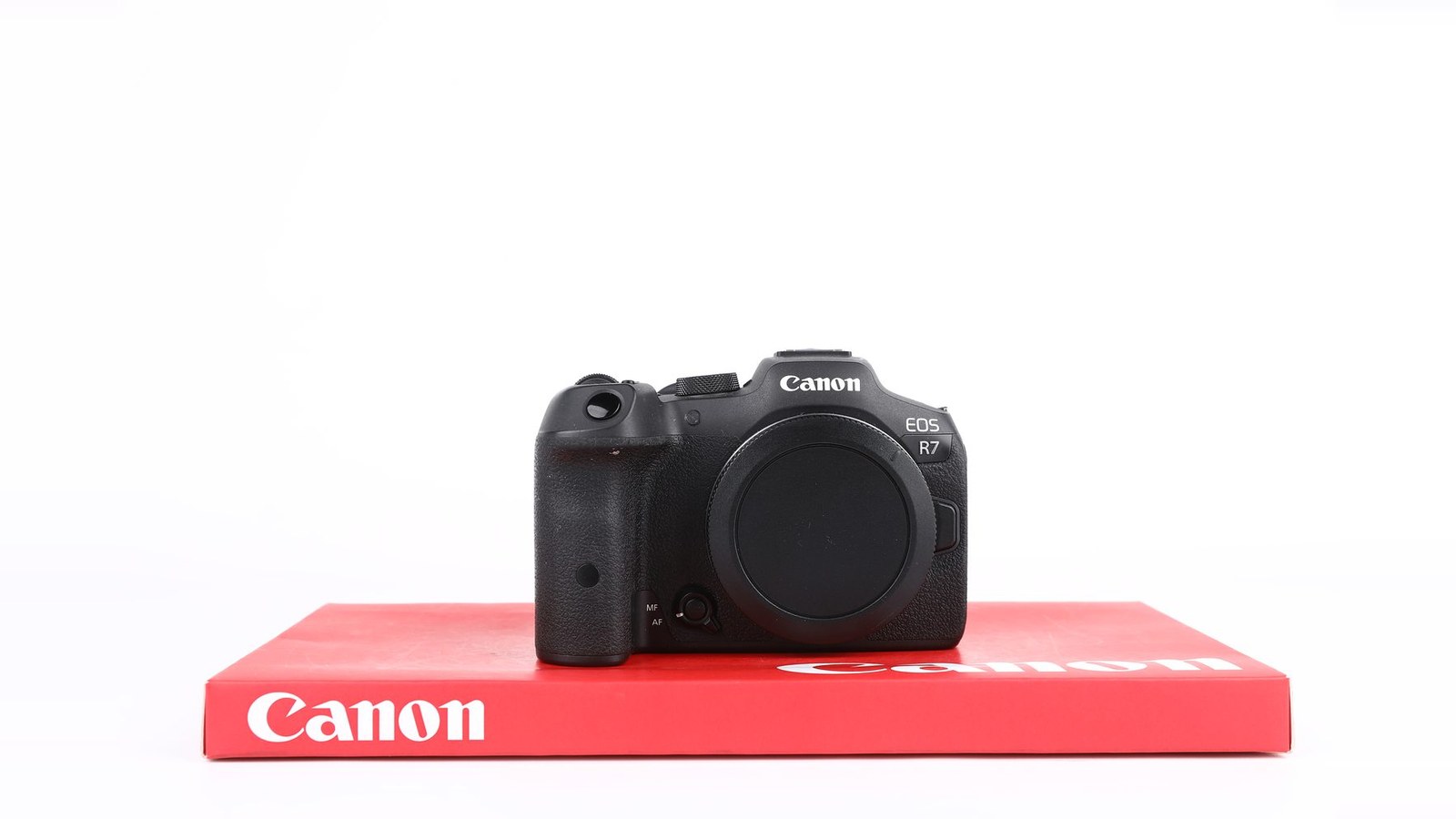
The R7 is the fastest APS-C camera Canon has ever put on the market: 15 fps with the mechanical shutter, 30 with the electronic one, on a 32.5 MP sensor. In the lineup, it does not replace an R6, as many assume at the counter. It fills the gap left by the 7D Mark II and 90D: the fast body for those who photograph animals and sports without having the budget for full frame.
This changes how you read it. Those who compare it to an R6 will be disappointed by the viewfinder and the noise at high ISOs. Those who compare it to the 7D Mark II they had in their bag in 2018 will find a clear leap in autofocus, burst rate, and stabilization.
The specs that really matter in the field
Half of the spec sheet will never be used. These are the numbers that change a shooting day:
| Specification | Value | What it means in practice |
|---|---|---|
| Sensor | APS-C 32.5 MP | High density: challenges mediocre lenses |
| Mechanical burst | 15 fps | The reliable figure, with AF-C active |
| Electronic burst | 30 fps | Only under specific conditions, pronounced rolling shutter |
| Memory slots | Dual SD UHS-II | Real-time backup on a race day that won't come again |
| Stabilization | IBIS up to 8 stops claimed | Lab data, see below |
| Viewfinder | 2.36 Mpt, 120 Hz | Modest resolution, excellent refresh |
| Battery | LP-E6NH | Same as R5 and R6; also accepts LP-E6N from 90D and 7D Mark II, with shorter battery life |
Regarding the 30 fps, clarity is needed: they are only available with the electronic shutter, and the R7's reads the sensor slowly — details further ahead. The 15 fps mechanical is the figure to rely on.
The up to 8-stop IBIS is valid with specific lenses, a stationary subject, and textbook bracing technique. On a 400 mm lens handheld, with a moving raptor, claiming 3-4 real stops is already honest. IBIS stabilizes the camera, not the animal.
What does "professional" mean in this context?
The R7 is sold as a professional body, and the right question is: professional compared to what. It is not an R3: the sensor is not stacked, the 2.36 Mpt viewfinder is the weakest point of the spec sheet in this price range, and the joystick is integrated into the rear dial — a solution that users coming from a 7D Mark II or 5D find uncomfortable for the first few weeks, and that some never get used to.
What holds up well is the weather sealing, which is good for the class, and the dual card slots. Otherwise, the R7 is a high-speed body built for those who cannot afford a fast full-frame, not a scaled-down flagship.
The 1.6x crop factor: what it gives you and what it doesn't
The 1.6x crop of the R7 is a geometric multiplication, not an optical one. The APS-C sensor crops the central portion of the image circle projected by the lens, and that crop is then filled by 32.5 MP. The result is a larger subject in the frame. Everything else — light gathered, bokeh, glass quality — remains exactly that of the lens you have mounted.
400 mm that become 640 mm: the math for wildlife photography
Here, the advantage is real and measurable. On a heron standing still at 40 meters, a 400 mm lens on full frame leaves the bird taking up about a third of the frame. On the R7, the same lens frames like a 640 mm: the heron fills the frame, and you don't have to crop in post.
There is, however, a catch. The cheapest 640 mm equivalent, the RF 100-400, works at f/8 at the long end. An adapted EF 400 f/5.6 costs more on the used market — 750-900 euros versus 550-650 — but gives you a full stop more, at the price of losing the zoom and optical stabilization.
Pixel density: why poor optics are more noticeable
32.5 MP on an APS-C sensor means pixels of approximately 3.2 microns. A 24 MP 80D, same format, was around 3.7 microns: it seems like a small difference, but it is the margin within which a mediocre lens went unnoticed. An old, budget EF 70-300 at full aperture, on that 80D, produced files that no one looked at critically — we discussed this in our review of the used 80D. On the R7, the same lens shows soft edges and chromatic aberration at 100%, because the sensor samples finer than the glass can resolve.
The crop does not give you extra stops of light
The practical scenario we hear most often at the counter: forest at dawn, RF 100-400 at 400 mm, hence f/8. To freeze a woodpecker's wings, you need at least 1/2000. With that combination, the sensor demands ISO 6400, sometimes 8000. The R7 produces recoverable but not clean files in that situation: chroma noise in the shadows is evident, and detail in the plumage gets smeared if you push noise reduction. The crop gave you framing, not exposure.
What your tele becomes on the R7 (1.6x crop)
| Lens | Equivalent focal length on R7 | Maximum aperture at long focal length | Practical notes |
|---|---|---|---|
| EF 70-300 f/4-5.6 IS II | 112-480 mm | f/5.6 | Good budget compromise, requires EF adapter |
| EF 400 f/5.6 L USM | 640 mm | f/5.6 | Fast AF, no stabilization: relies on the body's IBIS |
| RF 100-400 f/5.6-8 | 160-640 mm | f/8 | Light and affordable, but f/8 is a drawback in the forest and at dawn |
| RF 100-500 f/4.5-7.1 L | 160-800 mm | f/7.1 | The reference for bird photography, costs more than the body |
Autofocus and burst rate: where the R7 is unbeatable in its class
The R7's Dual Pixel CMOS AF II locks onto a flying heron against the sky before you've even finished raising the viewfinder. Against a clean background, subject recognition performs just as well as on a €3,000 camera body, which is why a used R7 at €900-1,100 remains the most sensible choice for wildlife photographers on a normal budget. The key is understanding where that system stops being magic.
Animal eye recognition: when it works and when it misses the mark
Subject isolated against a uniform sky, water, or grass background: immediate lock-on, eye tracking maintained even during approach. Dense undergrowth, intersecting branches, or fence mesh: tracking loses the subject and locks onto the first vertical contrast it finds. This occurs especially when the subject occupies less than one-fifth of the frame.
The advice we give at the counter is counterintuitive for those coming from a DSLR: use wide AF zone with animal recognition enabled, not single point. Single point on a moving subject forces you to chase it with the camera body, and on a fence wire you will lose it anyway. With a wide zone, the recognition system has enough data to make a decision.
30 fps electronic and the rolling shutter
This is the serious limitation of the R7. The electronic shutter reads the sensor too slowly for subjects with rapid perpendicular movement: swallow wings, helicopter blades, baseball bats, and panning with poles or tree trunks in the background come out visibly distorted, unrecoverable in post.
| Situation | Recommended mode |
|---|---|
| Soccer, athletics, rugby | Mechanical 15 fps |
| Flying birds, fast wings | Mechanical 15 fps |
| Panning against a background with verticals | Mechanical 15 fps |
| Slow or static subject, silence required | Electronic 30 fps |
Keep the mechanical shutter as your default and switch to the electronic one only when you need silence. Losing 15 fps costs less than an entire sequence with the blades folded.
Buffer and cards: why you need a UHS-II
In RAW, the long burst fills the buffer in seconds, after which the frame rate drops and depends solely on how quickly the card can be cleared. With a 90 MB/s UHS-I card, the camera remains locked up precisely when the subject does something interesting.
The R7 features two UHS-II SD slots: this is a concrete difference compared to the Canon EOS R50 V (€550, two units available), a compact and honest body but with only one memory slot. If you prioritize lightweight gear and do not require long bursts, we have detailed the logic of that family in our guide to the used Canon EOS R50. If you actually use burst mode, budget for two UHS-II V60 or V90 cards along with the body.
The hidden cost: telephoto lenses for the RF system
The used R7 body costs 900-1,100 euros. The telephoto lens that makes it useful costs anywhere from 550 to 2,600 euros. If you come to the counter with a total budget of 1,200 euros and want to photograph herons or motocross, you are about to make an allocation mistake, and it is worth saying so before you pay.
The problem is structural: the RF-S line, i.e., native APS-C lenses, has only one telephoto, the 55-210 f/5-7.1. At 210 mm on APS-C you get 336 mm equivalent with an f/7.1 aperture, which at dawn or under a forest canopy means extremely high ISOs and impossible fast shutter speeds. For the rest, you need to look at the full-frame RF lineup or used EF glass.
The three paths: native RF, adapted EF, none
| Solution | Indicative used cost | What you actually get |
|---|---|---|
| RF 100-400 f/5.6-8 | 550-650 € | 640 mm equivalent, 635 g, integrated IS. f/8 aperture at the long end: full sun or nothing |
| RF 100-500 f/4.5-7.1 L | 2.200-2.600 € | 800 mm equivalent, L quality, but alone it costs more than double the camera body |
| EF 400 f/5.6 L + adapter | 750-900 € | 640 mm equivalent at fixed f/5.6, excellent sharpness, no stabilizer |
| EF 100-400 f/4.5-5.6 L II + adapter | 1.100-1.400 € | The most balanced choice: zoom, IS, f/5.6 at the long end |
Let's dispel a recurring myth about EF adaptation: the EF-EOS R adapter is not an optical compromise. It is a tube with contacts, it has no lenses, and on recent USM lenses, autofocus works at the same speed as native. Where you feel the difference is on older lenses with micromotors, like the old EF 75-300: there, AF is slow and noisy, and it is the same on DSLRs. It is not the adapter's fault.
Why buying the R7 without a lens is a waste
With just the 18-150 kit lens, the R7 takes photos that a Canon EOS R100 costing 360 euros takes almost identically: same APS-C format, same performance at low ISOs, same result when printed at 30x40. What you pay extra for on the R7 — burst rate, subject tracking, dual slots, weather sealing — is only useful if you have a long lens in front of it. If you don't, you've bought a race car to go to the supermarket. We wrote a complete assessment of the used R100 for those who want to understand where an entry-level camera truly ends.
With a total budget of €1,200, a sensible allocation is different: the R100 at €360 or the Canon EOS R50 V at €550 as the camera body, and the remaining €650-850 on an RF 100-400 or an adapted EF 400 f/5.6. You can frame the distant subject, and that is what matters. The R7 makes sense as a second step, once you already have the telephoto and the bottleneck has become the camera body.
Buying a used R7: what to check before paying
The R7 units that reach our counter almost always carry a readable history. The studio body shows worn battery door seals and a shiny grip rubber. The field body has a high shutter count and slightly ovalized contacts in slot 1. The family body has 4,000 shutter count and the box is still full of plastic packaging. Knowing what you are looking at changes the negotiation.
Shutter count: which threshold makes sense
On the R7, the shutter count must be interpreted differently than on a portrait or travel body. Those who buy it for sports and wildlife work in bursts: 15 mechanical fps means that a three-second sequence of a starling flock produces 45 shutter count. Two seasons of hide shooting and cycling races reach 60,000 shutter count without effort, and this is not a sign of abuse.
Continuous sequences stress the mechanism less than repeated single shots: the shutter remains in cycle, without the full stop-and-restart sequence for every frame. This is why 60,000 shutter count on a well-maintained R7 tells a different wear story than 60,000 shutter count accumulated one by one on an EOS RP.
- Under 15,000: lightly used body, often bought and resold. Pay the full market price without hesitation.
- 15,000-60,000: the normal range for a used R7. No cause for alarm, just ask if there has been continuous professional use.
- 60,000-150,000: high but manageable, provided the body has been serviced. Here, the price should be 100-150 euros lower than a clean example.
- Over 150,000: buy it only with a genuine warranty and at a spare body price.
Shutter, IBIS and sensor
Three checks you can do in five minutes, in-store or at the seller's home.
- Shutter curtain: Set the mechanical shutter, take certified shutter count at 1/8000 and 1/4000 against a uniform wall. Darker bands on one side indicate curtains that are not closing in time.
- IBIS: Mount a 100 mm lens, take certified shutter count handheld at 1/15 with stabilizer on and then off. With functioning IBIS, the difference is evident at 100%. With the camera body off, moving the camera should produce a dry, light sound from the sensor: a continuous hum or metallic ticking with the camera body on indicates a failing actuator.
- Sensor: Take certified shutter count at f/16 against a white sky or blurred white sheet and view the file at 100%. Dust can be removed, but scratches on the filter cannot. On a 32.5 MP APS-C sensor, defects are visible much earlier than on a 24 MP full frame.
Dual slots, contacts and tropicalization
The dual UHS-II SD card slots are one of the main reasons for buying this camera, so you must test both with your own card. Use a flashlight to inspect the pins inside the slot: a card inserted at an angle can bend the contacts, and the only repair is replacing the entire assembly. Then check the battery contacts and the RF mount contacts: greenish oxidation is typical of bodies stored in humid environments.
When it comes to tropicalization, honesty is key: the R7 is weather-sealed, not waterproof. The seals on the side door and battery compartment flatten over time. If they are flat or cracked, I would not take that body out in the rain.
What we do in our workshop
Every R7 that comes to us goes through the bench before the warehouse: certified shutter count reading, shutter curtain inspection, sensor cleaning, IBIS test at different focal lengths, autofocus verification on a moving subject, and testing of both card slots. What doesn't pass the inspection doesn't go on sale. All used gear comes with a 2-year warranty, which is why we run these checks before you do.
How much does it cost used and which alternatives make sense
A used R7 in good condition today ranges between 900 and 1,100 euros for the body alone. Below 900, you find units with a high shutter count or missing the original box and accessories; above 1,100, you are usually paying for a kit, not a better body. The kit with the RF-S 18-150 costs more, but that lens is a travel all-rounder: it is not suitable for wildlife or sports, and paying for it within the kit means buying something you will resell.
Current price range for used equipment
There is a factor that compresses margins: the new R7 is regularly discounted. When the new price drops, the used price must be low enough to justify giving up the factory warranty. The practical consequence is simple: if the difference between a used unit and a new one on promotion is less than 200 euros, it is better to wait or consider buying new. If, however, the gap is 300-400 euros, the refurbished used unit is the most rational purchase in this price range.
Fast APS-C alternatives in our catalog
If your budget runs out sooner, there are three camera bodies in the shop that cost about half as much. None of the three can match the R7's animal autofocus — buy them knowing that.
| Model | Price | Key Strength | Limitation |
|---|---|---|---|
| Sony a6500 | 570 € | In-body image stabilization, 11 fps burst rate, compact body | Previous-generation AF: tracks, but does not recognize animal eyes |
| Fujifilm X-H1 | 650 € | DSLR-like ergonomics, deep grip, IBIS, robust build | Weak AF on subjects moving rapidly |
| Sony A6100 | 550 € | Reactive phase-detection AF, extremely lightweight | No in-body image stabilization, minimal ergonomics with heavy telephoto lenses |
What if your budget is for used full frame?
Here is the question we hear every week at the counter: with 600 euros, isn't a full frame better? A Canon EOS RP starts at 520 euros, and we have nine in stock. It is an excellent camera for portrait, travel, and landscape, but it shoots at 5 fps and has an autofocus system not designed for a falcon in flight.
For sports and nature, APS-C beats entry-level full frame, and it's not a paradox: burst speed and AF intelligence matter, not sensor size. In our lab, we test burst rate and tracking on every camera body before listing it for sale, precisely because on these machines, that parameter determines whether you get the shot.
Used Canon EOS R7 and alternatives available in store today
| Model | Sensor | Burst rate with AF-C | In-body stabilization | Indicative used price |
|---|---|---|---|---|
| Canon EOS R7 | APS-C 32.5 MP | 15 fps mech. / 30 fps elec. | Yes, up to 8 stops claimed | €900-1,100 |
| Sony a6500 | APS-C 24 MP | 11 fps | Yes, 5 stops claimed | €570 |
| Fujifilm X-H1 | APS-C 24 MP | 8 fps (14 elec.) | Yes, 5.5 stops claimed | €650 |
| Sony A6100 | APS-C 24 MP | 11 fps | No | €550 |
| Canon EOS RP | Full frame 26 MP | 5 fps (4 with AF-C) | No | €520 |
Who the R7 is for and who it isn't
The R7 is a specialist body disguised as an all-rounder. If you buy it to "have a modern Canon" and then use it for indoor portraits and holiday landscapes, you have spent €1,000 on features you will never touch. If you buy it knowing exactly what lens you intend to mount on it, however, you get performance that, just a few years ago, cost three times as much.
Worth it if...
The ideal profile is clear and rather narrow. Recognizing yourself in at least two of these lines is already a good sign.
- You already have EF telephoto lenses. A 70-200 f/2.8, a 100-400, or a 400 f/5.6 in your closet completely changes the equation. With the EF-EOS R adapter, those lenses become operational again, and the 1.6x crop factor extends their reach without any additional cost.
- You shoot wildlife in decent light. Not at dawn inside a closed hide, where ISO noise becomes an issue, but during peak daylight hours: herons in the lagoon mid-morning, raptors in flight, or garden feeders. In these conditions, bird eye detection works effectively, and the burst mode helps you capture the decisive moment.
- You shoot outdoor sports during the day. Youth soccer, athletics, cycling, or motocross. There is sufficient light to stay at 1/1000s without exceeding ISO 1600, and the subjects move along predictable trajectories.
- You are upgrading from a 7D Mark II or a 90D. The improvement is significant: subject recognition autofocus allows you to recover shots that you would have missed with the point-based system, and the electronic viewfinder shows you the exposure before you take the shot.
It's not worth it if...
These four situations regularly come up at the counter, and in all four cases, the honest advice is to look elsewhere.
- Indoor sports photographers. Gyms, pools, arenas. The issue there isn't frames per second but light stops: a full frame at ISO 12800 with an 85 f/1.8 produces usable files, a 32.5 MP APS-C much less. 30 fps won't recover an underexposure.
- You only have the kit zoom. An 18-150 on such a dense sensor shows all its limits at the edges, and at 150 mm you're at 240 mm equivalent: not enough for wildlife, too much for the rest.
- You take two hundred photos a year. The R7 lives on bursts and volumes. Those who use it two weekends a season are paying for a 15 fps shutter to take single shots.
- You're looking for portraits and landscapes. For that, the RF-S lineup stops at the 10-18 wide-angle, and the crop works against you: on wide-angle it takes away field of view, on portraits it takes away bokeh.
In our workshop, we often hear "I want it because it's fast." The follow-up question is always the same: fast for photographing what, and with which lens attached. If the answer doesn't come immediately, the R7 is almost never the right body.
Frequently Asked Questions
How many shutter count are too many on a used Canon EOS R7?
Below 15,000 shutter count, the camera body is practically like new. Between 15,000 and 60,000, it falls within the normal range and remains in full health, especially if it has been used in burst mode. Between 60,000 and 150,000, the price must drop by 100-150 euros compared to a clean specimen. Beyond 150,000, a shutter verification is required and it only makes sense as a backup body. We certify the shutter count on every camera body that enters our lab.
Are the 30 frames per second of the R7 actually usable?
Yes, but with discretion. The 30 fps are only available with the electronic shutter, which on the R7 exhibits pronounced rolling shutter: deformations appear on fast bird wings, rotating blades, or when panning against vertical backgrounds. For sports and wildlife photography, the sensible default is the mechanical shutter at 15 fps, which is already more than sufficient for game action or takeoffs.
Does the R7's IBIS really provide 8 stops of stabilization?
That number comes from a standardized measurement procedure, using a specific lens and a static subject. In practice, with a 400 mm lens in hand and a stationary subject, you can shoot around 1/40-1/60 with good results: that is approximately 3-4 real stops. And for sports and wildlife, stabilization is not meant to freeze the subject, which moves anyway: you need fast shutter speeds.
Can I use my Canon EF lenses on the R7?
Yes, with the EF-EOS R adapter. On recent USM and IS lenses, autofocus remains fast and precise, and data communication is complete. On older lenses with a micro motor, AF remains as slow as it was on the DSLR: the adapter does not work miracles. If you already have a 70-200 f/2.8 or a 400 f/5.6, the adapter is the most cost-effective way to start.
Is a used Canon EOS R7 better than a new R10?
It depends on what you shoot. The R7 features dual UHS-II SD card slots, in-body stabilization, superior weather sealing, and 32.5 MP that provide room to crop distant subjects. The R10 is lighter and more affordable but lacks IBIS and a dual slot. For wildlife photography with long telephoto lenses, the R7 offers a concrete advantage; for daytime sports with fast lenses, the difference narrows.
Is the R7 suitable for indoor sports like basketball or swimming?
That is his worst-case scenario. Indoors, you need stops of light, not frames per second: an APS-C sensor with an f/4-5.6 zoom ends up at ISO 12800 to hold 1/500. With a 70-200 f/2.8, the situation improves, but under those conditions, a used full-frame body with the same lens delivers cleaner files. Tell us before choosing: it completely changes the recommendation.
Is it better to buy a used R7 from a private seller or a shop?
As a private seller, you typically save 100-150 euros, but you don't know the shutter count of the camera body, whether the IBIS is intact, or if the sensor has been cleaned or scratched. On a body designed to work in burst mode and outdoors, in rain and dust, that information is worth more than the savings. With us, every used R7 goes through the lab and comes with a 2-year warranty.
Considering a used R7? Let's talk before you buy
If you have doubts about a purchase or need advice for your specific case, write to us. We offer free advice because we are photographers first, not just sellers, and because a customer who buys the wrong gear stops shooting.
Three ways to get in touch:
- Contact form — response within 24 business hours
- WhatsApp at 342 362 3454 (messages only)
- Phone: 071 291 6347 (Mon-Fri 9-13/15-18, Sat 9-13)
And if you want to see what we have in stock right away, explore the used gear available today: every camera is certified, comes with a 2-year warranty, and ships within 24-48 hours.
Article written by Matteo for the ReflexMania Team. Last updated: September 2026. Prices and availability refer to the time of publication.