
In short
- The used EOS R50 currently ranges from 450 to 600 euros for the body only, compared to about 800 euros for the new model with the 18-45mm kit.
- 24.2 MP APS-C sensor and Dual Pixel CMOS AF II with eye, animal, and vehicle detection: the same AF system as the R7, not a reduced version.
- It lacks in-body stabilization, has a single UHS-I SD slot, and an LP-E17 battery rated for approximately 370 certified shutter count CIPA (300-350 in practice): these are the three real limitations.
- In our lab, we check the certified shutter count, electronic shutter, sensor, and RF mount ring integrity before putting it on the shelf, with a 2-year warranty included.
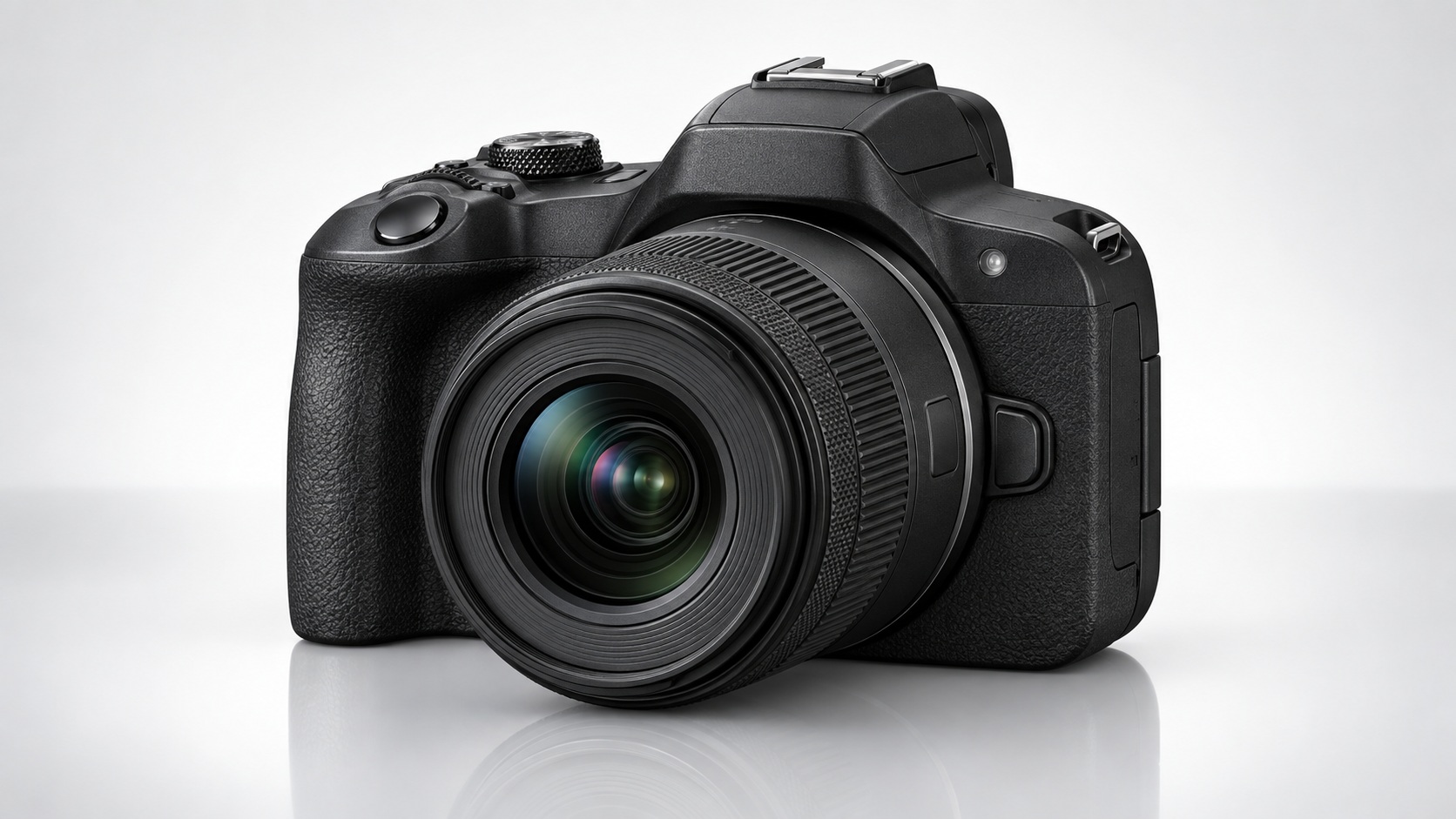
The EOS R50 is the camera I get asked about most often by people who come to the counter holding a smartphone and saying, "I want to take serious photos, but I don't want to carry around a brick." It weighs 375 grams with battery and card, fits in a city bag, and costs, on the used market, less than many lenses. It is also the camera where the most expectation errors occur: it is bought thinking it is a mini R7, and it is not.
In this article, I combine what I see coming through the workshop and what I hear customers asking at the counter: what a used R50 is really worth today, what changes compared to the R100 which costs 150 euros less, when it makes sense to spend those extra 50 euros on an R50 V, and in which cases it is better to skip APS-C entirely and go for a full frame like the EOS RP. No list of specifications copied from the Canon website: only the things that change the photos you take home.
What the EOS R50 really is and who it was designed for
The R50 is the camera Canon built to capture those who are done shooting with their phones. Released in 2023, it features a 24.2 MP APS-C sensor and the DIGIC X processor, the same one found in camera bodies costing three thousand euros. It is the direct commercial successor to the M50, but with an RF mount instead of the discontinued EF-M: a difference that matters more than any specification, because it determines whether your gear has a future.
The interesting point is where Canon decided not to cut corners. The worst way to look at an entry-level camera is to assume that every component is a watered-down version of the higher-end model. That is not the case with the R50.
The three things the R50 does better than its price
- Dual Pixel CMOS AF II Autofocus with 651 zones. The subject tracking system is inherited from the R6 Mark II: it recognizes eyes, faces, animals, and vehicles. It is not a reduced version; it is the same algorithm. On a portrait at f/2.8, it locks onto the eye and does not lose it while the subject walks towards you.
- 15 fps electronic burst, 12 fps mechanical burst. Numbers that ten years ago were found only on sports camera bodies. The limit is not the frame rate, but the buffer and the card — we discuss this below.
- 2.36 million dot OLED electronic viewfinder. In this price range, this is not a given: several direct competitors do not include a viewfinder at all, leaving you to compose on the rear screen even in full sunlight. The Canon EOS R100, which in our used inventory ranges between 375 and 400 euros, does have a viewfinder with the same resolution: what it lacks is a screen, which is fixed and not touch-enabled.
The three things it lacks that you cannot work around
These cannot be resolved with a firmware update or an accessory. They are design choices, and must be weighed before paying.
| Limitation | What actually happens |
|---|---|
| No in-body image stabilization (IBIS) | Handheld video while walking: micro-shake is visible. In-camera digital stabilization crops the image. For static shots under 1/60s, you rely solely on the lens, if it is stabilized. |
| Single UHS-I SD slot | UHS-I, not UHS-II: the card clears the buffer slowly. The 15 fps burst lasts briefly before slowing down. No real-time backup: if the card fails, the footage is lost. |
| LP-E17 battery, approx. 370 certified shutter count (CIPA) | In practice, expect around 300-350 real shots, less if you use the viewfinder heavily or record video. A day of travel requires two batteries, three if you are methodical. |
To put it bluntly: if you shoot a lot of talking-head video on a tripod, the lack of IBIS won't affect you. If you shoot video while walking, it will affect you every single time.
How much does a used R50 cost today and how has the depreciation trended
In 2023, the R50 launched at around 829 euros with the 18-45mm RF-S kit. Today, the new unit with the same kit is priced around 800 euros, while the used camera body ranges between 450 and 600 euros. Do the math for the same configuration: from the 829 euros of the launch kit to the 550-700 euros of today's used kit, that's roughly a 25-30% drop in three years, whereas a top-tier model easily loses 50-55% of its value over the same period.
The reason is not that the R50 is more robust or more desirable. It is that very few units reach the used market. Those who buy an entry-level camera keep it for years, or sell it directly to a friend who is just starting out. High-end models, on the other hand, change hands every time the next model is released: the professional sells the Mark II to buy the Mark III, and dozens of them end up on the market all at once. Less supply, stiffer prices.
What makes the difference between 450 and 600 euros
There is a €150 price gap between two identical camera bodies. The difference comes down to four factors, ranked by their actual impact on the price:
- Certified shutter count. A body with 8,000 shutter counts is worth about 100 euros more than one with 40,000. The difference is not so much the wear on the shutter as the fact that the latter has been seriously used, and with use come drops, dust, and worn dials.
- 18-45mm RF-S kit included. Adds 80-120 euros. It is not a great lens, but if you are starting from scratch, you need something on the mount.
- Original LP-E17 battery. A Chinese compatible one costs 15 euros and delivers barely 250 out of the 370 certified shutter counts. It weighs 30-40 euros on the price.
- Box, documents, remaining warranty. They count for less than one might think: 20-30 euros.
A camera body at €450 with 40,000 shutter count and a compatible battery is not a bargain compared to one at €580 with 8,000 shutter count and kit included. It is simply a different camera.
Why certified used gear costs more than private sales (and when it makes sense)
The difference between a private listing and the same camera from us is 70-120 euros. That difference covers three concrete things: the lab test with reading of the certified shutter count, 2-year warranty and the right of withdrawal. On a R50 costing 550 euros, it means that if the AF stops locking on in the fourteenth month, the camera comes back here; it does not become your problem.
To be honest: if you can read a shutter count, inspect the sensor in backlight, and test the AF on a target, buy from a private seller and save money. If you can't, those 100 euros are the cheapest insurance there is — a sensor that needs cleaning at a service center costs 80, and a shutter costs 250.
For price reference in our catalog: the Canon EOS R50 V is priced at 550 euros, but it is a video-centric camera without a viewfinder, not an upgrade to the R50. The Canon EOS R100 starts at 375 euros and is the step below, featuring previous-generation AF: we discussed it in detail in our in-depth guide on the used R100.
R50 vs R100, R50 V and EOS RP: where the line is drawn
Anyone walking into the shop with 600 euros in their pocket usually compares the same four camera bodies, and almost always does it wrong: they look at the price and release date, not what actually changes in real-world use. The dividing line between these four doesn't lie in the price list, but in three things — the viewfinder, the AF generation, and the sensor format.
| Model | Used Price | Viewfinder | Key Strength |
|---|---|---|---|
| Canon EOS R50 | €450-600 | Yes, electronic | Latest-generation AF in a 375 g body |
| Canon EOS R100 | €375-400 | Yes, electronic | The lowest entry price for the RF mount |
| Canon EOS R50 V | €550 | No | 4K 60p and headphone output |
| Canon EOS RP | €570-600 | Yes, electronic | 26 MP full-frame sensor |
R100 at €375-400: what you are really giving up
We have eight Canon EOS R100 units in our catalog, priced between 375 and 400 euros. Compared to the R50, it lacks four specific features: previous-generation AF without vehicle recognition and significantly less tenacious tracking for moving people; a fixed, non-touch screen, meaning no top-down framing or touch-to-focus; a burst rate limited to 6.5 fps, which is insufficient for sports; and 4K video with heavy crop and contrast-detection autofocus, resulting in the classic focus hunting.
That said: if you shoot landscape, travel, still life, and family photos in decent light, the R100 delivers the same type of files as the R50. It also features a 24 MP APS-C sensor from a previous generation, but with performance that is practically identical at low ISOs. Saving 150 euros on the camera body and investing in a better lens is a choice we endorse every day.
R50 V at 550 euros: the same base, opposite philosophy
The Canon EOS R50 V is not an updated R50, but an R50 reorganized for video: 4K 60p, headphone output, dedicated video profile dial, and a body with a rethought tripod mount. We have two units available at 550 euros. The price is fair for those who shoot video.
The point that goes unmentioned in reviews is that it has no electronic viewfinder. In August, at two in the afternoon, composing on an LCD under direct sunlight is an exercise in faith. For those who create spoken content, it makes no difference. For those who shoot outdoors, it is a daily compromise.
EOS RP at €570-600: the full frame that costs as much as an APS-C
The Canon EOS RP is priced between 570 and 600 euros at our store, with eight units in stock, featuring a 26 MP full-frame sensor. On paper, it is the obvious choice. The hidden cost lies elsewhere: a bright full-frame RF lens costs about twice as much as its RF-S equivalent, and without suitable lenses, the format advantage remains on the spec sheet. The second limitation is the autofocus, which is two generations behind that of the R50: on a subject moving towards you, the difference is evident in the discarded files.
The real issue with the R50: the RF-S lens lineup
The R50's limitation isn't in the camera body; it's in front of the mount. Canon has opened the RF mount to third-party manufacturers only for APS-C autofocus lenses, and the result is that native RF-S lenses can be counted on one hand. Almost all are zooms with slow apertures, designed for tourists rather than for shooting indoors or at dusk. Anyone buying an R50 without doing this math ends up with an excellent autofocus attached to an f/6.3.
The three RF-S lenses that actually exist and their used prices
| Lens | Used indicative | What it's for |
|---|---|---|
| RF-S 18-45mm f/4.5-6.3 IS STM | 150-180 € | Standard kit, ultra-compact, short zoom range |
| RF-S 18-150mm f/3.5-6.3 IS STM | 330-400 € | Travel all-rounder, the only one that covers everything |
| RF-S 55-210mm f/5-7.1 IS STM | 240-280 € | Lightweight telephoto for outdoor sports and distant portraits |
The common issue is written in the missing column: aperture. At 210mm you are at f/7.1, and without in-body stabilization, you are left with only the lens's optical stabilizer. Indoors or after sunset, this means raising ISOs above 6400 or accepting motion blur.
RF full frame on the R50: which ones make sense
Full-frame RF lenses mount without an adapter, and APS-C sensors use the central portion with a 1.6x crop factor. Two are truly worth the money:
- RF 50mm f/1.8 STM, approx. 120 € used: on the R50 it frames like an 80mm. It becomes a tight portrait lens, not a lens for interiors. With f/1.8 you recover over three stops compared to RF-S zooms.
- RF 16mm f/2.8 STM, approx. 200 € used: it frames like a 26mm. It is the wide-angle lens that is truly needed for those doing handheld talking-head videos or shooting in small rooms.
The EF-EOS R adapter and the used Canon market
This is the real economic lever of the R50. With an EF-EOS R adapter, which costs around €100 used, you unlock the entire EF lens park built over thirty years. A used EF 50mm f/1.8 STM costs €80, an EF-S 10-18mm is around €160, and a 24-105mm f/4 L IS can be found for €450. These are the same lenses you would have mounted on a DSLR like the used Canon 80D, and on the R50 they retain autofocus and automatic exposure.
The math is simple: a €100 adapter plus an €80 50mm lens gives you a true fast prime for less than the cost of a used kit zoom alone. The only price you pay is bulk, as the adapter extends the camera body by approximately 24 mm, negating some of the compactness that led you to choose the R50.
What to check on a used R50 before paying
An R50 with fewer than 20,000 shutter count is essentially a new camera, and the price difference compared to a unit with 60,000 can be 80 euros. It is worth spending ten minutes to check, especially if you are buying from a private seller and have no warranty coverage. This is the sequence we follow, reduced to what you can do with the camera in hand and a phone.
Shutter count and shutter wear
Canon does not state a shutter life for the R50, nor does it for any entry-level model in the range. The practical reference for this tier is approximately 100,000 cycles, but this is a category estimate, not an official figure: it serves to frame wear, not to promise an expiration date.
The count does not appear in the menus. You read it with a dedicated utility like ShutterCount, which queries the camera connected via USB: on RF bodies, this is the reliable method, because the counter is not a standard EXIF field and online services do not always find it. Two concrete warnings:
- If you go the file route, use one just taken and unmodified: a JPEG that has passed through Lightroom or WhatsApp has lost the useful fields.
- Shutter count from the electronic shutter counts little towards mechanical wear but is included in the total: a high count on a camera used for video and silent bursts does not equate to 60,000 shutter actuations.
Sensor, rolling shutter and defective pixels
Three tests in five minutes, all handheld:
- Dust: white wall, f/16 or f/22, focus at infinity, slightly overexposed photo. Dust particles appear as blurred dark spots. A few specks are normal and can be cleaned; an oily haze is not.
- Hot pixel: lens cap mounted, 12,800 ISO, 2-second exposure. You should see black with uniform noise, not fixed red or green dots.
- Rolling shutter: switch to the electronic shutter and perform a quick pan across a pole or a doorframe. On the R50, the distortion is pronounced; it is a design limitation and not a defect — but if you need the silent electronic shutter, you must see how much it skews before buying.
Mount, articulating screen and contacts
Mount a lens and try to move it sideways: the RF ring must be firm, with no play or clicks. Then open and close the vari-angle screen about ten times, rotating it on both axes: the hinge is the most fragile mechanical point of this body, and any wobble or display flicker in a specific position is a serious issue that needs repair.
Two quick checks remain: the gold contacts in the battery compartment must be clean, free from green or whitish oxidation, and the SD card door must close with a crisp click. A tired spring inside means accidental openings while the camera is in your bag.
What we do in our workshop before putting it on the shelf
Out of every ten R50 units we receive via trade-in or direct purchase, one or two never make it to the shelf. Not because they are visibly broken: usually, it is a defect the seller had not noticed, such as autofocus hunting in continuous mode or a control dial that skips one shutter count out of five. Those units are returned or used for parts. The rest pass through the workbench and always follow the same sequence.
- Shutter count reading. Canon does not display it in the menu on RF entry-level models, so we read it via software with the camera body connected. It is the first piece of data that ends up in the product sheet.
- Wet sensor cleaning and check at f/16. A shot on a uniform background at a closed aperture, where every speck becomes visible. If fixed spots remain after two passes, the issue is not dust and it is a different matter.
- AF test on a high-contrast target. We verify the Dual Pixel CMOS AF II both in single and servo modes, with eye detection on a real subject: if something fails to lock on, it is immediately visible.
- Electronic and mechanical shutters tested separately. Full burst on both, checking for banding and lines in the files.
- Firmware aligned to the latest available Canon version. It takes five minutes and resolves a portion of the anomalous behaviors that private sellers mistake for faults.
- LP-E17 battery under load. It is not enough that it turns on: a tired cell holds the power-on but collapses after eighty shutter counts. If it does not hold, we replace it before sale.
- Mechanical integrity of the RF mount. Lens mounted, light controlled torsion, verification that there is no lateral play and that the contacts communicate without interruptions.
Everything is wrapped up by the 2-year warranty, which matches the coverage period for new units. This is not a commercial gesture: it is the result of our testing. If we were not reasonably confident in the camera body, two years of coverage would be a liability for us, not a reassurance for the customer.
Why the certified shutter count changes the negotiation
Take two R50s that are visually identical, both rated 9 out of 10, both with box and charger. The first has 9,000 shutter count, the second 47,000. To the naked eye, you cannot tell them apart: the R50 has a polycarbonate body that shows little wear, and the typical wear points — battery compartment edge, thumb grip — are still slight even at 47,000 shutter count.
The real difference is in remaining lifespan, and that has a price. Here, those two units end up on the shelf with an 80-120 euro difference within the 450-600 euro range, and the number is written on the spec sheet, not just mentioned verbally. The same criterion applies to the rest of the catalog: a Canon EOS RP at 570 euros and one at 600 euros do not differ based on the seller's friendliness, but on shutter count and included accessories. The same goes for the Canon EOS R50 V at 550 euros, where the data carries even more weight because it is a camera used primarily for video.
When you buy from a private seller and they tell you "few shutter count," ask for the number read via ShutterCount with the camera body connected, not a figure from memory. It is the only verifiable answer.
When the R50 is not the right choice
The R50 is an honest camera, but there are three types of photographers for whom it is the wrong purchase. We see them at the counter every week: people who come back after two months frustrated, not because the camera is defective, but because it was not the right one for how they shoot. Better to say it upfront.
If you shoot a lot indoors or at night
Three drawbacks come into play here: a 24.2 MP APS-C sensor, no in-body stabilization, and a kit zoom that reaches f/6.3 at 45mm. Above 3,200 ISO, image quality visibly degrades, and without IBIS you cannot compensate by slowing down the shutter speed. With an 18-45mm f/6.3 in a church or at a dinner, you are forced to use 6,400 ISO to achieve 1/60.
Within the same price range, you can find used full-frame bodies. The Sony A7 at 400 euros features a 24 MP full-frame sensor that at 6,400 ISO delivers what an APS-C sensor achieves at 3,200: a real gain of over one stop. The Sony A7 Mark II at 570 euros adds 5-axis in-body stabilization, which is worth another two or three stops for stationary subjects.
However, the compromises are serious and must be stated: first-generation hybrid autofocus, slow and less reliable in tracking compared to the R50's Dual Pixel, no reliable eye detection, 2013-2014 ergonomics and menus, and NP-FW50 batteries with short life. If you need sharp portraits of running children, the R50 wins. If you photograph static interiors, the full frame wins. We wrote a dedicated piece on what to really expect from a used first-generation A7.
If you're coming from a DSLR and shooting in bursts all day
The R50 has a single SD UHS-I slot, and this is the bottleneck: the buffer clears slowly, so after a long RAW burst you are left waiting. Add the LP-E17 battery with a CIPA rating of approximately 370 shutter counts, and you understand that a day of sports or wedding photography requires three or four spare batteries.
- No file backup: with a single slot, a corrupted card means lost work.
- No official battery grip: you cannot double the battery life on the camera body.
- 375 g camera body: lightweight, but with a heavy telephoto lens, the balance in hand becomes uncomfortable after hours.
If you work this way, look for bodies built to keep up with the pace: a used Sony A6500 at 600 euros features IBIS and a more generous buffer, while prosumer DSLRs with dual slots and a battery grip — such as a Canon 7D Mark II or a Nikon D500 — cost less than you might think. Ask us what we have in stock at any given time, as availability for these bodies changes from week to week.
If your total budget is under 500 euros for body plus lens
This is the case where we say no most often. An R50 at 500 euros leaves you with zero margin for a decent lens, so you end up with the f/6.3 kit zoom and the camera performs much less than it could. Better to step down on the body and step up on the optics: a Sony A6000 between 342 and 360 euros, or a Canon EOS R100 at 375 euros, frees up 150 euros for a 35mm f/1.8 or a fast 50mm.
A 2014 camera body paired with an f/1.8 prime lens produces better images than a 2023 body with a slow zoom. It delivers in low light, in bokeh, and in sharpness at full aperture. This is the advice we give most often, and the one that results in the fewest disappointed customers.
The growth path: from R50 to what you step up to
Most buyers who purchase an R50 today keep it for two or three years. Then one of two things happens: either photography remains an occasional hobby and the camera body is fine as it is, or it becomes a serious pursuit and the desire for full frame emerges. The key point is that the second path costs significantly less if you bought the lenses with that in mind from the start.
The RF mount is a single standard, but lenses are divided into two families. RF lenses cover full frame and mount on any Canon mirrorless camera body. RF-S lenses are designed for APS-C and, when mounted on a full frame body, automatically force a crop: an R8 with 24 MP drops to approximately 9.6 MP effective. It works, but you paid for a sensor you are not using.
Buying lenses that survive a camera body change
The rule we give at the counter to anyone buying an R50 with the intention of upgrading within two or three years is simple: buy RF-S lenses only when there is no sensible alternative, i.e., for wide-angle.
- Standard zoom: if full frame is on your roadmap, the RF-S 18-45mm remains an accessory to resell. A 24-105mm RF is heavier, but you will never need to replace it again.
- Portrait: a 50mm or an 85mm RF full frame lens on APS-C becomes an 80mm or 136mm equivalent. These are excellent focal lengths for portrait photography right now, and they remain perfect after the switch.
- Adapted EF: with the EF-EOS R adapter, you gain access to twenty years of used optics at prices RF lenses do not reach. AF works well with Dual Pixel, the glass is full frame, and the investment survives two or three camera body upgrades.
- Wide angle: this is where the RF-S makes sense. A true full frame wide angle lens costs twice as much, and you cannot fully utilize it on APS-C anyway.
If you are still considering staying with APS-C in the long term, comparing it with the other platform is useful: we discussed this in the analysis of the used Sony A6700, where the APS-C lens lineup is a completely different story.
What the R50 is worth when you resell it
A R50 bought used today for 500 euros, kept for two or three years with a normal shutter count, realistically resells for between 300 and 380 euros. The loss is 120-200 euros over three years: in the mirrorless market, it is one of the lowest depreciations, precisely because the pool of people entering the Canon system does not run out.
As for where to land, the two entry points to used full-frame RF are the Canon EOS RP, available from 570 euros and representing the most affordable access to Canon's full-frame mirrorless format, and the Canon EOS R at 800 euros, which offers a sturdier camera body and a significantly better viewfinder. With trade-in, the deal is settled in one go: we appraise the R50 in our lab, and you pay the difference, without having to manage listings, negotiations, or shipments to strangers.
Frequently asked questions
How much does a used Canon EOS R50 cost in 2026?
The camera body alone is priced between 450 and 600 euros, depending on the shutter count and the included accessories. With the RF-S 18-45mm kit, the price rises to 550-700 euros. The new kit is currently priced around 800 euros: the actual savings on the used market are therefore 20-30 percent, not 50 percent as with older models.
Does the Canon EOS R50 have stabilization?
Not on the sensor. It only has the optical image stabilization of IS lenses and, in video, a digital stabilization that crops the image by about ten percent. For photos, this means that when shooting handheld with a 50mm lens, you should stay above 1/80 of a second. For handheld video without a gimbal, the result remains shaky.
How many shutter count does the EOS R50 shutter last?
Canon does not declare an official value for the R50. For Canon entry-level models of this generation, the mechanical cycle count is estimated at around 100,000, and a significant portion of the shutter count is handled by the electronic shutter. A used unit with 15,000 shutter count has consumed approximately 15 percent of the shutter's expected lifespan.
Is a used Canon EOS R50 better than a full-frame EOS RP at the same price?
It depends on what you photograph. The RP has a full frame sensor and better high ISO performance, but an autofocus system two generations older and RF lenses that cost twice as much as RF-S. If you photograph moving subjects, sports, or children, the R50 will give you more sharp shutter count. If you shoot portraits and landscapes with a relaxed pace, the RP offers a real advantage in file quality.
Can I use Canon EF lenses on the R50?
Yes, with the EF-EOS R adapter, which costs about 100 euros used. There is no loss of optical quality or autofocus speed with recent EF USM and STM lenses. It is the most cost-effective strategy to build a fast lens kit: a used EF 50mm f/1.8 STM costs 80 euros, compared to about 120 euros for the RF version.
Is the R50 suitable for shooting video for YouTube or Instagram?
For in-camera audio, yes: articulating screen, reliable Dual Pixel AF II on faces, 4K 30p without crop, microphone input. The limitations are the lack of a headphone output and overheating after about 30-40 minutes of continuous 4K. If video is the primary use, the R50 V at 550 euros is the most sensible choice: it adds 4K 60p and a headphone output, but gives up the viewfinder.
What should I check when buying a R50 from a private seller?
Shutter count read with an utility like ShutterCount with the camera connected, sensor photographed at f/16 against a white wall to check for dust, hinge of the articulating screen (the most fragile mechanical point), play of the RF mount and battery contacts. Always ask if the battery is the original LP-E17: compatible ones degrade after 100-150 cycles and cost 60 euros to replace.
Want a tested R50 with a 2-year warranty?
If you have doubts about a purchase or need advice for your specific case, contact us. We offer free advice because we are photographers first, and because a customer who makes a poor purchase will not return to photography.
Three ways to get in touch:
- Contact form — response within 24 business hours
- WhatsApp at 342 362 3454 (messages only)
- Phone: 071 291 6347 (Mon-Fri 9-13/15-18, Sat 9-13)
If you want to see what we have in stock right away, explore the used gear available today: every camera is certified, comes with a 2-year warranty, and ships within 24-48 hours.
Article written by Matteo for the ReflexMania Team. Last updated: September 2026. Prices and availability as of the date of publication.