
In short
- The three versions cost approximately 350-450 euros (Mark I, 2001), 550-700 euros (Mark II, 2007) and 1,000-1,250 euros (Mark III, 2016) on the used market: between the first and the third, the price is almost triple.
- At 16 mm and f/2.8, the Mark III is the only one sharp to the corners on full frame. Mark I and II remain soft at the edges even at f/5.6, and stars in the corners turn into small streaks.
- If you don't need f/2.8, a used EF 16-35 f/4L IS at 550-650 euros offers better edges than the Mark II and includes image stabilization: for landscape photography on a tripod, it is often the most sensible purchase.
- With the EF-RF adapter, all three focus well on Canon EOS R and EOS RP. On APS-C bodies like the R100, they become a 26-56 mm equivalent and lose the reason for buying them.
The same question often comes up at the counter, usually from someone who just saw a listing for a 16-35 f/2.8L at 400 euros: “Why does the Mark III cost three times as much? Is it really that different?” We have serviced quite a few in our lab, from all three generations, and the answer is that it depends on what you photograph and how closely you inspect the corners. For a wedding photographer shooting at the center of the frame in a dark hall, the Mark II is still excellent. For those photographing the Milky Way at f/2.8, however, the difference is visible in the very first shot.
In this article, we compare the three versions of the EF 16-35 f/2.8L on what matters in the used market: edge sharpness, build quality, weight, filters, use on Canon mirrorless cameras with an adapter, and typical defects to check before paying. At the end, you will find a table linking each type of photography to the right version, and two more affordable alternatives that are sometimes a better deal. No copied spec sheets: only what you can see in the photos and at the test bench.
Three versions in fifteen years: what really changed
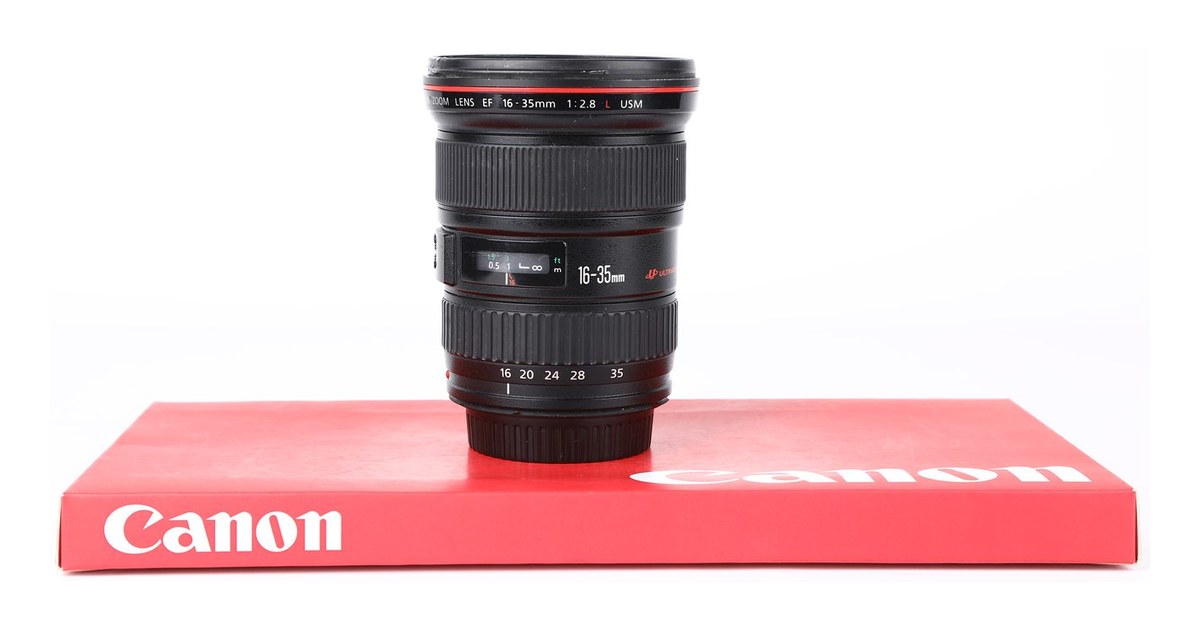
In the used section, you will find three different lenses with the same name, EF 16-35mm f/2.8L USM. They differ in optical design, filter diameter, weight, and weather sealing. Before comparing the offers, check which version is for sale: this is indicated by the text on the barrel, «II» or «III» after «USM».
| Mark I | Mark II | Mark III | |
|---|---|---|---|
| Year | 2001 | 2007 | 2016 |
| Filter | 77 mm | 82 mm | 82 mm |
| Weight | 500 g | 640 g | 790 g |
| Aperture blades | 7 | 7 | 9 |
| Weather sealing | No | Yes | Yes |
| Used price | 350-450 € | 550-700 € | 1.000-1.250 € |
Mark I (2001): the zoom of digital-era photojournalists
It was released before the EOS-1Ds in 2002, when full-frame digital was virtually non-existent. It was designed for film and early low-megapixel sensors. On a 20-30 MP camera body, its limitations are immediately apparent, especially away from the center. It remains the lightest of the three and uses 77 mm filters, but it has no declared weather sealing. Units in circulation often have twenty years of use behind them, and mechanical condition matters more than the spec sheet.
Mark II (2007): sharper in the center, edges still weak
Canon redesigned the optical scheme, switched to an 82 mm filter, and added a seal to the mount. The jump compared to the Mark I is significant in the center. At the corners, at 16 mm, the improvement is much smaller. It is the most common version on the used market, as it was the standard wide-angle zoom for Canon users for nearly ten years.
Mark III (2016): the complete redesign
On the Canon spec sheet, you'll find large-diameter aspherical lenses, SWC and ASC coatings, fluorine on the outer elements, and a 9-blade diaphragm. In practice, each of these features translates into a specific result:
- Larger aspherical elements: usable angles even at f/2.8, without needing to stop down the aperture.
- SWC and ASC: less flare and fewer ghost reflections when the sun enters the frame.
- Fluorine coating: droplets and fingerprints wipe off with a cloth, no rubbing required.
- 9 blades: 18-point starbursts on streetlights and rounder bokeh when stopped down.
Among these features, the one that justifies the double price of the Mark II is edge sharpness; the others are real but secondary advantages.
Edge sharpness: where the Mark III outperforms the other two
At the center, at f/5.6, the three versions look much more alike than the price difference suggests. The gap becomes visible in the corners of the full frame, at 16 mm and wide open. Those shooting reportage or weddings focus on the subject in the center and rarely on the top-right corner. For these photos, the difference matters little.
At 16 mm and f/2.8: the test that separates the versions
On a 5D Mark IV or an EOS R, the Mark I and Mark II show smeared corners at full aperture. Fine details are lost and contrast drops. The Mark III remains sharp to the edge, with a drop-off where the first version is already blurry. The Milky Way makes the difference evident. With the first two versions, stars in the corners turn into small streaks or gulls with open wings. With the Mark III, they remain points, or nearly so.
| Version | Corners at 16 mm f/2.8 | Corners at 16 mm f/8 | At 35 mm |
|---|---|---|---|
| Mark I (2001) | Soft, pronounced coma | Acceptable, below the others | Decent from f/5.6 |
| Mark II (2007) | Soft, evident coma | Good, not excellent | Good |
| Mark III (2016) | Sharp, controlled coma | Very good | Very good |
From f/8 upwards, the separation decreases, but does not disappear
For landscape photography on a tripod, you almost always stop down to f/8 or f/11. Here, the Mark II becomes a serious tool, and those who use it this way rarely complain. However, the extreme corners remain a step below the Mark III. On screen, in a photo resized for Instagram, no one will see it. On a 30x45 print or larger, with branches or rocks reaching the edge, it becomes visible. At 35 mm, the differences shrink even further: there, even the Mark I performs well from f/5.6.
Backlight and starbursts
With the sun in the frame, the Mark III's SWC and ASC coatings make a difference: the first two versions can sometimes leave colored spots and a veil that lowers contrast. Then there is the aperture:
- Mark I and Mark II: 7 blades, resulting in 14 rays around the sun and streetlights when the aperture is closed.
- Mark III: 9 blades, resulting in 18 rays, which are denser and more regular.
It is an aesthetic detail, not a technical one. However, for those shooting architecture at night or cityscapes with streetlights in frame, it is part of the look you are after. For everyone else, it does not justify an extra 500 euros on its own.
Build, weight, and filters: hidden costs that weigh on your choice
There is a 290-gram difference between the Mark I and Mark III: 500 g versus 790 g. On a tripod, it makes no difference. However, during an eight-hour trek with the camera body, a second zoom lens, and water in the backpack, you will feel it. Yet, weight is the smallest hidden cost. The real expense comes when buying filters.
77 mm vs 82 mm: those who already own filters save money
The Mark I uses 77 mm filters, the same thread size as many L-series zooms of its era: EF 17-40 f/4L, EF 24-105 f/4L, EF 70-200 f/2.8L, and the first EF 24-70 f/2.8L. If you already own one of these lenses, you already have the filters and won't spend anything extra. The Mark II and III use 82 mm filters, which cost 15-25% more for the same quality. A landscape kit with a polarizer, a 10-stop ND filter, and a protective filter, chosen from mid-range brands like Hoya HD or B+W, costs approximately:
- 77 mm kit: approx. 230-280 euros
- 82 mm kit: approx. 280-340 euros
- 100 mm square filter holder with 82 mm ring, two step-down rings and an ND: 500-700 euros, i.e. more than a used Mark I
If you need to buy filters from scratch, our advice is to get 82 mm ones right away. With a 77 to 82 mm adapter ring, which costs just a few euros, they also fit 77 mm lenses. The reverse does not work: a 77 mm filter will not mount on an 82 mm thread, and even with an adapter, it would cause vignetting. A warning for those working at 16 mm: standard polarizers tend to darken the corners, so a slim mount is required. At 16 mm, the polarizer also creates uneven sky darkening, a flaw that no filter can correct.
Weather sealing: what it really means
The Mark I does not have seals declared by Canon. The Mark II and Mark III do, featuring a rubber seal on the mount and seals on the dials. There is a detail many discover late: when zooming, the front element retracts into the barrel, and without anything in front, the system remains open. To seal it, a front filter is required, even just a clear protective filter of 82 mm. Without that filter, the weather sealing is incomplete.
In practice, with a filter mounted and a weather-sealed body, a Mark II or a Mark III handles light rain, mist, and waterfall splashes well. Prolonged downpours, saltwater spray, and submersion remain outside the scope of its sealing. In the workshop, lenses with internal condensation or oxidation almost always come from a day at the sea without a filter, not from a thunderstorm. The Mark I should be treated as a dry-weather lens: in the rain, a rain cover is required, which costs 15-20 euros and protects it better than any seal.
Canon mirrorless with EF-RF adapter: it works, with one exception
At the counter, we get asked this almost every week: does the 16-35 EF work on a Canon mirrorless? With the EF-EOS R adapter, the answer is yes, for all three versions. Autofocus, aperture control, and EXIF data transfer without loss. The adapter is a tube with contacts, no glass in between, so the optical performance remains identical. The issue isn't the adapter; it's the sensor you mount it on.
The electronic viewfinder helps exactly where this lens is most delicate. At 16 mm, you see the actual exposure and the edges of the frame before the shutter count. Using the viewfinder magnification, you check the focus near the corner, something that with the optical viewfinder of a DSLR was done by eye.
EOS R and EOS RP: the affordable full-frame that makes sense
A Canon EOS RP, today at 600 euros, is the most affordable full-frame Canon in our catalog for using the 16-35 with its true field of view: 26 megapixels in a compact camera body. The Canon EOS R, ranging from 690 to 800 euros, steps up to 30 megapixels, is more robust, and features a battery with longer life. For those printing large-format landscapes, the extra megapixels make a difference.
With a Mark I or a Mark II, the camera body and lens together cost between 950 and 1,500 euros, adapter excluded. This is the same price or less than the used RF 15-35 f/2.8L alone, which today is found between 1,300 and 1,500 euros. With the Mark III, the cost exceeds that of the RF, so it is worth doing the math before choosing.
A note on the Mark I: the motor is over twenty years old, and on these camera bodies it focuses slightly slower than the other two. For landscape and architecture, there is no difference. In reportage with moving subjects, the difference is noticeable.
APS-C like the R100 makes no sense
On the Canon EOS R100, which we have between 360 and 400 euros, the 1.6 crop factor turns the 16-35 into a 26-56 mm equivalent. It is no longer a wide-angle but a short standard zoom. The numbers don't add up:
- Field of view: the 16 mm, the very reason for buying this lens, disappears.
- Weight: from 500 to 790 grams plus the adapter, on a body that weighs less than the lens.
- Price: from 350 to 1,250 euros for the lens on a body costing less than 400.
There is a paradox: on APS-C, the soft edges of the Mark I are barely noticeable because the sensor only uses the central part of the image circle. However, paying for an f/2.8L to exploit the center is not a good deal. For the R100, a native wide-angle lens like the RF-S 10-18 mm f/4.5-6.3 IS STM is the better choice. It covers a 16-29 mm equivalent, is stabilized, and weighs a fraction of the 16-35.
Which version for which photography
Before choosing the version, it is worth asking how many of your photos have something important in the corners. If the answer is "almost none", the Mark III is a cost you do not need. However, if landscape or architecture fills the entire frame, previous versions will leave you unsatisfied with every print.
| Main use | Recommended version | Reason |
|---|---|---|
| Weddings, events, receptions | Mark II | f/2.8 with subject in the center, edges less visible |
| Low-light indoor reportage | Mark II | Best price-performance ratio |
| Group photos at f/8, tight budget | Mark I | Under 400 euros, it does the job |
| Astrophotography | Mark III | Pinpoint stars to the corners at f/2.8 |
| Print landscape, real estate interiors | Mark III | Sharp lines and details across the entire frame |
| Tripod landscape, no need for f/2.8 | EF 16-35 f/4L IS | Better edges than the II, image stabilization, costs less |
Mark I: only at a low price and with a checked unit
The first version makes sense under 400 euros for those who frequently shoot around 35 mm or stop down to f/8 for group photos. Above that price, the difference compared to a Mark II at 550 euros is too small to justify a lens that is twenty-five years old. In that case, it is worth adding a bit more and moving to the II.
Mark II: the pragmatic choice for events and reportage
During a wedding, at f/2.8 the subject is almost always centered in the frame. No one notices the soft corners in a reception hall, neither the couple nor those flipping through the album. For those working in low light, the Mark II currently offers the best price-to-performance ratio.
Mark III: when the angles are the subject
Whether it's a starry sky, a 60x90 cm landscape print, or a photo of a living room for sale, the corners are part of the image. Here, the €400–500 premium over the Mark II is visible in every shutter count.
The alternative we often recommend: f/4L IS
At the counter, we often advise against the 16-35 f/2.8. The used EF 16-35 f/4L IS costs 550-650 euros, has better edges than the Mark II, accepts 77 mm filters, and features a 4-stop image stabilizer. In practice, it allows for handheld shutter counts of 1/4 second when shooting buildings or interiors. However, the stabilizer does not freeze moving people: for events, you still need f/2.8. Those with an even tighter budget can consider the EF 17-40 f/4L, which is cheaper and lighter.
What we check at the lab on a used 16-35 f/2.8L
A 16-35 f/2.8L that has worked for years on weddings and events has almost always taken a few hits. At our counter, we see them come in with the same three or four flaws, and almost none of them are mentioned in private seller listings. Here is what we look for, and how you can check for them yourself before paying.
Decentration: The flaw no listing declares
After even a minor drop, one of the optical groups can shift slightly. The result is one side of the frame appearing softer than the other. This is much more noticeable on a wide-angle lens than on a telephoto, because at 16 mm the edges are the most exposed part.
The test is simple: a flat wall or facade, the camera parallel to the surface, 16 mm and f/2.8. Zoom in to 100% on the four corners and compare them. Do not expect sharp corners on Mark I and II: expect corners that are equally soft. If one is clearly worse than the other three, the lens is decentered. Repeat at 35 mm for confirmation.
Front lens and internal dust
The front element is highly curved and protrudes: simply placing it incorrectly on a table can scratch it. During zooming, the front group moves within the barrel, and over the years, some dust may enter. A few specks are not visible in photos. Deep scratches, haze, and mold filaments, however, are visible, especially in backlight.
A LED torch is required for the inspection. Remove the caps, shine the light from the rear at an oblique angle, and observe from the front while slowly rotating the lens. Dust appears as isolated specks, haze as a uniform milky veil, and mold as spiderwebs. The latter two are sufficient reasons not to buy.
USM autofocus, aperture and dials
These are the checks we perform on every unit, and which you can repeat in ten minutes with your camera body:
- USM Motor: Focus from minimum distance to infinity must be fast, silent, and continuous. Shutter counts, buzzing, or hesitations indicate a tired motor.
- Aperture: Set f/22 and take certified shutter counts at 16, 24, and 35 mm. If Err 01 appears or the exposure jumps between one certified shutter count and the next, the problem lies in the contacts or the aperture flat.
- Zoom Ring: Rotate it through its full range multiple times. It must be uniform, with no hard spots. On Mark I models with many years of use, a stiffened ring is common.
- Focus Ring: In manual mode, it must rotate smoothly, without lateral play.
At ReflexMania, every 16-35 we put up for sale undergoes these tests in our Ancona lab before being added to the catalog. We do not sell centered or hazy specimens as good. All used items come with a 2-year warranty: if a defect emerges after purchase, the lens is returned to us.
The complete budget: body plus 16-35, three real combinations
With €1,300 today, you can put together a full-frame Canon body with a serious f/2.8 wide-angle lens. The figures below are based on our catalog prices for camera bodies and market ranges for lenses. Always add the cost of the base EF-EOS R adapter to the lens price; used, it typically runs around €80–100.
| Combination | Camera body | Lens | Indicative total | For whom |
|---|---|---|---|---|
| Entry-level | EOS RP, 600 € | Mark II, 600-650 € | 1.280-1.350 € | Events, travel, interiors |
| Mid-range | EOS R, 690-800 € | Mark II, 600-650 € | 1.370-1.550 € | Weddings and full-day reportage |
| Landscape | EOS R, 690-800 € | Mark III, 1.000-1.250 € | 1.770-2.150 € | Print landscape, astro, architecture |
Around €1,300: EOS RP and Mark II
The Canon EOS RP we have for 600 euros is the most affordable full-frame Canon we sell, featuring 26 megapixels and a lightweight body. With a Mark II for 600 euros and the adapter, you stay around 1,290 euros. The real limitation of the RP is the small LP-E17 battery: for a ten-hour wedding, you need at least three. For events and travel, where corners matter less, it is the most sensible combination for those starting from scratch.
Around €2,000: EOS R and Mark III
For landscape and astrophotography, it is better to invest in the lens than the camera body. A used Canon EOS R priced between 690 and 800 euros features 30 megapixels and uses the LP-E6N battery, the same as the 5D and 6D DSLRs. Paired with the Mark III, it delivers sharp edges even at maximum aperture. A newer body with a Mark I would yield cleaner files at high ISOs, but with soft corners that no sensor can recover.
There is also an economic reason. A camera body loses value with each new generation, while a well-maintained L-series zoom lens, resold after three years, retains a significantly higher percentage of its original price. The rule we apply at the counter is simple:
- Spend on the camera body if you photograph moving people in low light, because that's where autofocus and noise matter.
- Spend on the lens if you work on a tripod at low ISO, because that's where only what the lens delivers to the sensor counts.
Complete your kit with a standard zoom
The 16-35 covers the wide-angle, but on its own it is not enough for an entire assignment. The most common pairing we see is with an EF 24-105 f/4L: together they cover from 16 to 105 mm and overlap only between 24 and 35 mm. Those who choose the Mark I or the f/4L IS also have a practical advantage, because, like the 24-105, they use 77 mm filters. With the Mark II and Mark III, you need an 82 mm set, to be used on the 24-105 with a 77 to 82 mm adapter ring. To choose between the two versions of the standard zoom, find the complete comparison in our article on Canon 24-105 f/4L used: first or second version.
Frequently asked questions
Is the Canon 16-35 f/2.8L Mark II still worth it in 2026?
Yes, for events, weddings, and indoor reportage, where f/2.8 is required and the subject is centered in the frame. It is not the right choice if you photograph stars or landscapes for large prints, because at 16 mm the corners remain a step below the Mark III, even when stopping down to f/8-f/11.
Is the Mark III really worth twice as much as the Mark II?
Only if the corners of your images matter in your photos. For astrophotography, architecture, and landscape, the difference is visible in every shutter count. For people photos at f/2.8 in a dim room, the Mark II performs almost identically and leaves you €400–500 for something else.
Does the 16-35 f/2.8L EF work well on Canon EOS R and EOS RP?
Yes. With the EF-RF adapter, autofocus, aperture control, and EXIF data function normally on all three versions. Please note that neither the EOS R nor the EOS RP has in-body image stabilization, and no version of the 16-35 f/2.8L is stabilized. The Mark I focuses a bit more slowly, but for a wide-angle lens, this is rarely an issue.
Is the 16-35 f/4L IS or the used 16-35 f/2.8L II the better choice?
For landscape and tripod use, the f/4L IS is the better choice: wider angles, image stabilization, 77 mm filters, and a similar price. The f/2.8 II remains preferable only if you need the extra stop of light for indoor events or moving subjects in low light.
How do I know if a used 16-35 is decentered?
Shoot a flat, distant surface, such as a facade, at 16 mm and f/2.8, keeping the camera perfectly parallel. Then compare the four corners enlarged at 100%: if one is noticeably softer than the others, the lens is probably decentered, usually due to a drop.
Is a bit of dust inside the lens a problem?
A few specks are normal on a zoom lens with a moving front element and are not visible in photos. The situation is different in the case of haze, fungus, or deep scratches on the front element, which lower contrast in backlit conditions and should be assessed before purchase.
Looking for a checked 16-35 f/2.8L? Let's talk
If you have doubts about a purchase or need advice for your specific case, contact us. We offer free advice because we are photographers first and sellers second, and because a customer who buys poorly won't return to photography.
Three ways to reach us:
- Contact form — response within 24 business hours
- WhatsApp at 342 362 3454 (messages only)
- Phone: 071 291 6347 (Mon-Fri 9-13/15-18, Sat 9-13)
And if you want to see what we have in stock right away, explore the used items available today: every camera is certified, comes with a 2-year warranty, and is shipped within 24-48 hours.
Article written by Matteo for the ReflexMania Team. Last updated: November 2026. Prices and availability refer to the time of publication.