
In short
- For birdwatching, you need at least 400mm equivalent: below that threshold, the subject remains a dot in the frame even at 20 meters distance.
- A used 150-600mm f/5-6.3 costs between 550 and 900 euros depending on the manufacturer and year, compared to 1,100-1,300 euros for new.
- On APS-C, the 1.5x-1.6x crop turns a 400mm into 600mm equivalent: a Sony a6500 at 600 euros with a third-party telephoto lens costs less than a full frame with the same reach.
- The factor that ruins the most shutter count in wildlife photography is not the sharpness of the lens but the shutter speed: below 1/1000s on a moving passerine, motion blur is almost guaranteed.
The first long telephoto lens I bought was a 400mm f/5.6 without stabilization. I took it on three outings in a wetland area near Ancona and came back with 600 files, of which perhaps eight were usable. It wasn't the lens's fault: it was mine, for not understanding that a long telephoto amplifies every technical error exactly as it amplifies the subject. Since then, at the counter, when someone asks me "which tele for birds," I always try to explain two things together: which glass makes sense to buy and what really happens when you have it in your hands.
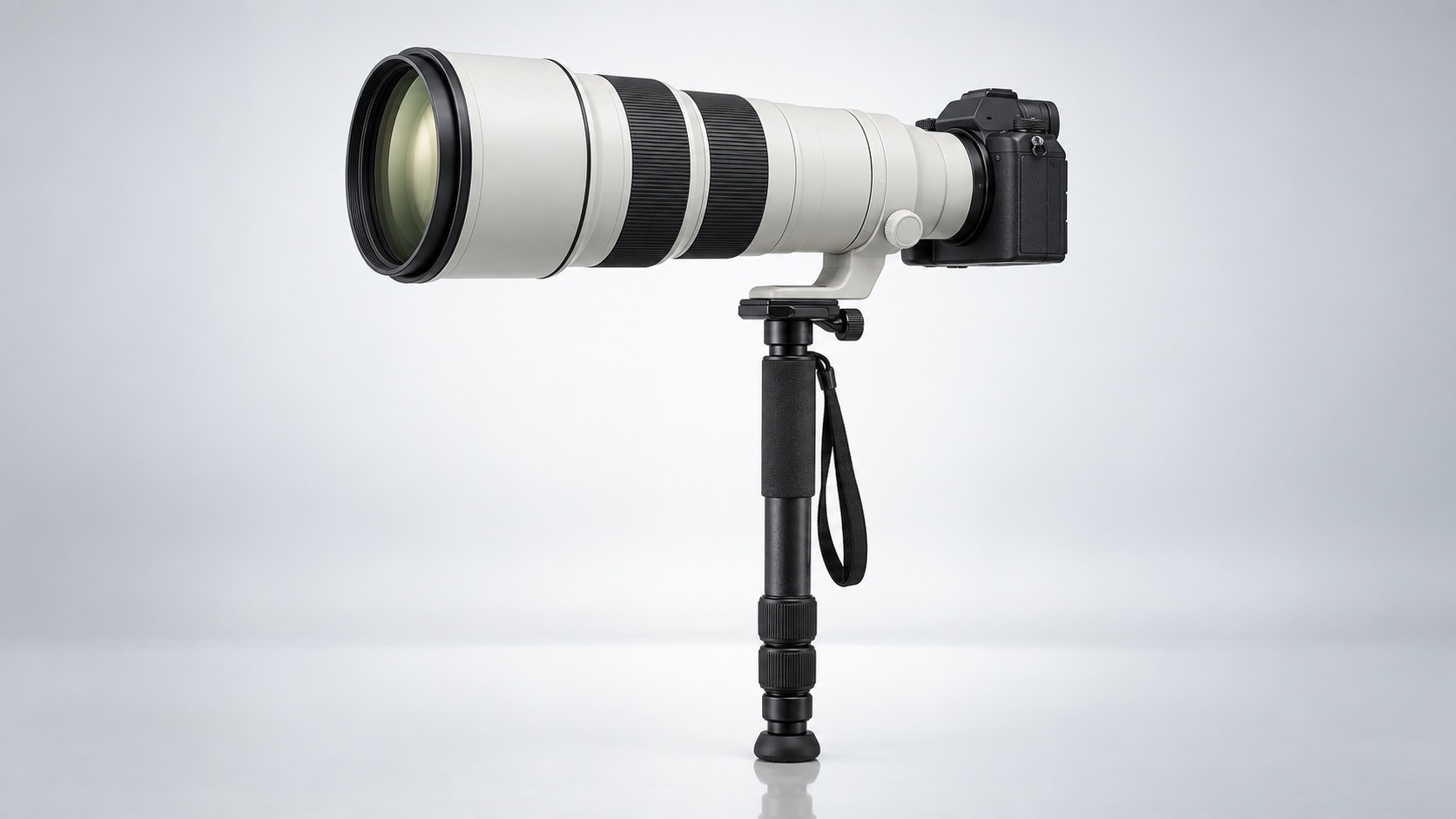
This guide lists the used telephoto lenses I recommend for wildlife photography and birdwatching, organized by actual price range, with the limitations of each clearly stated. You will also find what to check on a second-hand telephoto lens before paying, why the camera body matters less than you think, and in which cases the expense is not worth it and you should stop. There is no absolute ranking: it depends on what you photograph, how much you walk, and how much you are willing to carry on your shoulders.
How many millimeters do you really need for birds
The question I hear most often at the counter is whether a 70-300mm is enough for birdwatching. The short answer is no, and it’s not a matter of opinion: it’s geometry. The subject occupies a portion of the frame that can be calculated, and with 300mm that portion is too small to withstand cropping in post.
The math of distance: why 300mm is not enough
Take a tit: 14 cm long, perched on a branch at 35 meters, which is the actual distance at which you find it without a hide. On a full frame, with a 300mm, it occupies about 5% of the frame height. On a 24-megapixel file, this means a subject just over 200 pixels tall. To bring it to a printable size, you have to crop down to a tenth of the file's width, and at that point you are working with less than one megapixel.
At 600mm from the same distance, you reach 10% of the height, i.e., approximately 400 pixels. It may seem little, but the usable crop goes from useless to decent. Here are the numbers for the same magpie at 35 meters, full frame:
| Focal length | % frame height | Subject pixels (24 MP) | Usable crop |
|---|---|---|---|
| 300mm | ~5% | ~200 px | No |
| 400mm | ~6.5% | ~270 px | On the edge |
| 600mm | ~10% | ~400 px | Yes, for web and small print |
The practical threshold is 400mm equivalent. Below that, you are buying a general-purpose telephoto, not a birding lens.
APS-C crop factor as a free multiplier
On Canon APS-C the factor is 1.6x, on Sony and Fujifilm 1.5x. A 400mm lens mounted on Sony frames like a 600mm equivalent, on Canon like a 640mm. It’s not magic: the smaller sensor crops, it doesn’t add optical detail. The real advantage is that you get that crop from the full sensor, with all its pixels, instead of being forced to do it in Lightroom by throwing away half the file.
For this reason, a Sony a6500 at 600 euros, with in-body stabilization and adequate burst rate, remains a solid foundation for wildlife photography: with a third-party telephoto lens, it costs less than a full-frame camera with the same reach. The same logic applies to the Canon EOS R100, which we have in stock between 360 and 400 euros across 9 units: an essential body, but the 1.6x crop factor is the same as all Canon APS-C models.
Raptors, herons, and waders: when 400mm is enough
Not everyone needs 600mm. A grey heron is one meter long: at 20 meters with a 400mm lens, it fills the frame vertically without cropping. The same applies to cormorants, storks, and raptors photographed in flight, where an excessive focal length actually makes it difficult to track the subject. In the hides of coastal reserves, distances drop to 10-15 meters, and 400mm is more than sufficient. If your hunting ground is wetlands and not the undergrowth, save on the telephoto and invest in the camera body.
The three price ranges of used telephoto lenses worth buying
The used market for long telephoto lenses is divided into three distinct tiers, and the price jump between each corresponds to a real leap in performance. Under €400, you get limited reach and slow autofocus. Between €500 and €900, you get 600mm lenses. Above €1,000, you pay for optical quality and aperture, with the cost measured in kilograms. Those who skip a tier hoping for a compromise usually resell within a year.
Under 400 euros: entry-level 70-300 and 55-250 zooms
Here you will find the Canon EF 70-300mm f/4-5.6 IS II for around 280-330 euros, the Nikon AF-P 70-300mm for 180-250 euros, the Canon EF-S 55-250mm STM for 150-190 euros, and the Sony E 55-210mm for 120-160 euros. These are honest lenses: sharp in the center up to 200mm, soft at the edges and at the extreme long end, with autofocus that struggles to track a subject changing direction. The Nikon AF-P and the Canon 70-300 IS II have significantly faster motors than the other two.
This zoom lens serves one purpose, and it does it well: finding out if you truly enjoy wildlife photography before spending 800 euros. On APS-C, the 70-300 reaches 450-480mm equivalent, which is sufficient for herons, gulls, and raptors in flight. You will find it short on passerines, and you will discover that after three outings.
500-900 euros: third-party 150-600mm superzooms
This is the price range where about 70% of our wildlife photography clients fall, and it is the right choice for most of them.
| Model | Used Price | Weight | Note |
|---|---|---|---|
| Sigma 150-600mm Contemporary | 550-750 € | 1.930 g | The lightest in its category, excellent for handheld shooting |
| Tamron 150-600mm G2 | 700-900 € | 2.000 g | More effective stabilization and AF than its predecessor |
| Sigma 100-400mm Contemporary | 500-650 € | 1.160 g | Less reach, but it fits in your backpack pocket |
The stated stabilization is 4 stops, but on long focal lengths the real gain we see is 2-2.5 stops, because angular shake at 600mm is amplified. And at f/6.3 on the extreme long end, with forest light or at dusk, you go up to ISO 3200-6400 to hold 1/1000s. The limit of this range is not sharpness: it is the aperture.
Over €1,000: Stabilized 100-400s and older prime lenses
The Canon EF 100-400mm L IS II is priced around €1,100–1,400, and the Nikon 200-500mm f/5.6E around €800–1,000: both offer superior autofocus and optical performance compared to superzooms, with consistent quality across all focal lengths. Then there are the first-generation 500mm f/4 lenses, which have dropped to clearance prices compared to their original list price.
To be clear about those primes: a 3.8 kg lens requires a proper tripod and a solid ball head, adding to both the weight and the budget. If your birdwatching involves walking 10 km with a backpack, that glass will stay at home.
Used telephoto lenses for wildlife photography: focal length ranges, weight, and indicative price
| Lens | Focal length on APS-C (equiv.) | Max aperture | Weight | Indicative used price |
|---|---|---|---|---|
| Canon EF-S 55-250mm STM | 88-400mm | f/4-5.6 | 375 g | 150-190 € |
| Nikon AF-P 70-300mm | 105-450mm | f/4.5-6.3 | 400 g | 180-250 € |
| Sigma 100-400mm Contemporary | 150-600mm | f/5-6.3 | 1.160 g | 500-650 € |
| Sigma 150-600mm Contemporary | 225-900mm | f/5-6.3 | 1.930 g | 550-750 € |
| Tamron 150-600mm G2 | 225-900mm | f/5-6.3 | 2.000 g | 700-900 € |
| Nikon 200-500mm f/5.6E | 300-750mm | f/5.6 fixed | 2.300 g | 800-1.000 € |
| Canon EF 100-400mm L IS II | 160-640mm | f/4.5-5.6 | 1.640 g | 1.100-1.400 € |
The camera body matters less than the glass (but not zero)
If you have a total budget of 1,500 euros, the right allocation is approximately 500 for the camera body and 1,000 for the telephoto lens. The opposite — 1,100 for the body and 400 for the tele — produces worse photos, and I see it every month at the counter. An entry-level 70-300mm on a modern camera remains an entry-level 70-300mm: the sensor does not recover the missing reach, nor the edge sharpness at 300mm. That said, the body is not irrelevant: it impacts three specific aspects, and it is worth spending on those.
AF tracking and burst rate: the two parameters that matter
In wildlife photography, the camera body serves two purposes: tracking a subject that moves unpredictably and capturing enough frames to secure a good pose. Everything else — megapixels, articulating screen, 4K video — matters little in birdwatching.
| Body | Burst | AF | ReflexMania Price |
|---|---|---|---|
| Sony A7 Mark III | 10 fps | 693 phase-detection points | 705 euros |
| Sony a6500 | 11 fps | 425 phase-detection points, APS-C | 600 euros |
| Canon EOS RP | 5 fps | Dual Pixel, less responsive on erratic subjects | from 520 euros |
| Canon EOS R100 | 6.5 fps | APS-C, entry level | from 360 euros |
The difference between 5 and 10 fps is not academic. A wren turning on a branch stays in the right pose for less than half a second: at 5 fps you get two or three frames, at 10 you get five. The EOS RP is an excellent camera for landscape and portrait at that price, but for moving wildlife it is the wrong choice on the price list. The same reasoning applies to sports, and I developed it in the article on equipment for sports photography.
Why I often recommend APS-C over full frame
For 600 euros you can get an a6500 or, for 400, a first-generation Sony A7. For bird photography, the a6500 wins hands down: the 1.5x crop factor turns a 400mm lens into 600mm equivalent, it features 5-axis IBIS, and it shoots at 11 fps compared to the A7's 5 fps, whose first-generation hybrid AF loses focus on erratic subjects.
The honest counter-argument: full frame wins on noise. In the undergrowth, with an f/6.3 and 1/1000s shutter speeds, you regularly find yourself at ISO 3200-6400, and that is where the APS-C shows its limit. If you mostly shoot in dense woods or at dusk, the A7 Mark III at 705 euros is the best compromise in the catalog: high burst rate and a modern full frame sensor.
What to check on a used telephoto lens before paying
On a 50mm, there are two critical defects: fungus and sticky aperture blades. On a 150-600mm, there are at least six failure points, and almost all stem from weight. A 1.9 kg superzoom with a barrel that extends by 12 centimeters subjects the barrel, AF motor, and stabilizer to stresses that a short prime never sees. Here is what we look for when a telephoto lens comes in for trade-in.
Zoom creep, play and extended barrel
The test takes ten seconds. Zoom to 600mm, point the lens at the floor, and release the ring. If the barrel drops on its own, the internal friction is worn out. This is not a cosmetic defect: in the field, it means the focal length changes on its own every time you shift the camera on your shoulder.
On most 150-600 lenses, the mechanical lock engages only at 150mm (the Tamron G2 is the exception: its Flex Zoom Lock locks at any focal length). It is intended for transport and does not resolve creep at long focal lengths: if the seller presents it as a reassurance, they are masking the issue. Also check for lateral play: with the barrel extended to 600mm, grasp the front section and try to move it vertically. A tenth of a millimeter of slack is physiological, but a movement visible to the naked eye is not.
Stabilizer: the 3-second test
Turn on the stabilizer at half-press and count to three while looking through the viewfinder. This is what should happen:
- Sound: a low, continuous hum. A metallic ticking or a sharp click upon activation indicates the moving group hitting the stops.
- Settling: the image stops within one second. If it continues to drift slowly in one direction — what we call "swimming" — the centering of the group is lost.
- Power-off: upon release, there should be a small recoil snap, not a violent jump of the framing.
The IS and VC systems in third-party superzooms released between 2013 and 2016 are the first components to fail on these lenses. They are also the least cost-effective repair: often, the quote exceeds the residual value of the lens.
Decentring and long-throw AF
Decentering is only visible at long focal lengths. Frame a flat, detailed subject — a brick wall, a newspaper page on the wall — perfectly parallel to the sensor, take a shot at 600mm, and compare the four corners at 100%. If one corner is noticeably softer than the others and the defect persists after rotating the lens, the optical group is misaligned.
For autofocus, the test is a full range of motion: force focus from the minimum distance to infinity and back, five or six times. On telephoto lenses, the moving group is heavy, and a worn motor will stall mid-travel or slow down noticeably in one direction. The rest of the optical checks — fungus, dust, haze, scratches on the front element — apply as they do to any other lens, and we have compiled them in the guide to checking for fungus, dust, and scratches.
Focal length multipliers: when they make sense and when they don't
The teleconverter is the accessory we sell most often to customers who later come back to the counter to resell it. It costs little compared to a longer telephoto lens, promises an additional 1.4x or 2x reach, and fits in your pocket. On paper, it is the perfect upgrade for birdwatching. In practice, on the f/5-6.3 superzooms that almost everyone uses for birds, it performs poorly and in many cases worsens the final result.
1.4x and 2x: What You Lose in Light and AF
The math is straightforward and non-negotiable. A 1.4x multiplier costs 1 stop of light, a 2x costs 2. A 150-600mm f/6.3 at the long end becomes an 840mm f/9 with the 1.4x, and a 1200mm f/13 with the 2x. The latter is out of the question on any camera body: most AF systems fail to lock focus.
| Configuration | Focal Length | Max Aperture |
|---|---|---|
| 150-600mm bare | 600mm | f/6.3 |
| 150-600mm + 1.4x | 840mm | f/9 |
| 150-600mm + 2x | 1200mm | f/13 |
The real issue isn't the light, it's the autofocus. Many Canon and Nikon DSLRs disable the cross-type points and leave only the center one active, when they leave it active at all, beyond f/8. Recent mirrorless cameras handle it better, but they still slow down: the sensor receives less light and tracking a moving subject becomes uncertain. And in the woods at f/9, with the 1/1000s shutter speed needed to freeze a passerine, the ISO climbs to 6400 and above. The noise eats up the detail that the crop factor would have added.
The 1.4x makes sense in one specific case: a fast prime lens, such as a 300mm f/4 or a 400mm f/5.6. There, you move to f/5.6 or f/8 with limited sharpness loss, and the AF remains usable. On an f/6.3 superzoom, almost never.
The alternative: cropping in post
With a 24 MP sensor, you can crop half the width and half the height, leaving you with 6 MP. That is sufficient for an A4 print and more than enough for any web or social media use. That crop is equivalent to doubling the focal length, for free, without losing a stop and without compromising AF.
The real comparison is between two imperfect images: the crop starts from a sharp shutter count taken at f/6.3 and low ISO, while the multiplier starts from a soft shutter count taken at f/9 and high ISO. In our experience at the counter, the crop wins almost every time, especially with third-party multipliers not designed for that specific lens.
- Sensible crop factor: prime lens f/4 or faster, good light, stationary subject.
- Crop factor to avoid: superzoom f/6.3, dense undergrowth, birds in flight.
- Sensible crop: always, provided the source file is in focus and correctly exposed.
Technique: The parameters that save your shutter count more than the gear
90% of the blurry shutter counts I see at the counter are not caused by the lens. They result from a shutter speed chosen for a static scene and applied to an animal that is constantly moving. A €800 150-600mm with incorrect settings produces worse files than a €200 70-300mm set up properly. Before changing glass, it is worth checking the three parameters that follow.
Minimum shutter speeds by subject
The reciprocal rule of the focal length — 1/600s on a 600mm — exists to compensate for hand shake, not subject movement. A fishing heron remains still for entire seconds. A robin on a branch turns its head multiple times per second, and the head is exactly what needs to be sharp. These are two different scenes that require different shutter speeds.
| Subject | Minimum shutter speed | Note |
|---|---|---|
| Heron, stork, perched raptor | 1/500s | Large and slow subject, the stabilizer really helps |
| Perched passerine | 1/1000s | Constant micro-movements of the head |
| Bird in flight | 1/2000s | Below this threshold, wingtips always blur |
| Takeoff, close-up wingbeat | 1/3200s | Requires full light, otherwise it's not feasible |
At f/6.3, these shutter speeds force high ISOs. This is the real trade-off in wildlife photography: a sharp file at ISO 6400 is better than a clean but blurry one. Noise can be reduced in post-processing; motion blur cannot.
Auto ISO with limit: how I set it up
In the field, I always prioritize shutter speed. I set the shutter speed myself based on the expected subject, leave ISO on auto with a maximum limit of 6400, and keep the aperture wide open by necessity. This way, the exposure follows the passing clouds without me touching anything, while the shutter speed remains exactly as I decided.
- ISO ceiling 6400: beyond this, on APS-C sensors released before 2018, feather detail disappears.
- Exposure compensation +2/3 EV with a bright sky behind the subject, otherwise you get a silhouette.
- Continuous AF with zone area, not single point: on a small and irregular subject, single point loses focus and locks onto branches.
- Medium burst rate, not maximum: fills the buffer less and leaves more usable shutter count per sequence.
Monopods and supports: the right support for 2 kg of glass
The landscape tripod, the one we recommend for long exposures in the essential landscape gear guide, is dead weight in itinerant birdwatching. If you walk 4 km along a levee, a monopod with a tilt head costing 60-90 euros supports the weight and allows you to rotate to follow the flight. From a fixed hide, even simple solutions work: a bag filled with rice resting on the car window, or your forearm pressed against the hide railing. Both eliminate more shake than two stops of declared stabilization.
Three complete configurations with a realistic budget
Three kits assembled with camera bodies currently in our stock, with prices summed up and no hiding of each one's limitations. The prices of the telephoto lenses are those of the Italian used market that I described in the price ranges section: they vary by 50-100 euros depending on the condition, so consider it a range, not a fixed price list.
Entry-level kit under 900 euros
The Canon EOS R100 starts at 360 euros, and we have nine units in stock. It is the camera body that helps you determine, for a low investment, whether wildlife photography is a true passion or just a three-trip curiosity. With an adapted 55-250mm EF-S lens, the total cost is around 510-550 euros; with a used 70-300mm lens, it is around 640-690 euros. In both cases, you get 400-480mm equivalent focal length thanks to the 1.6x crop.
The stated limitation: the AF does not track a passerine that changes direction, and the burst rate cannot keep up with a takeoff. It works perfectly on a stationary heron, a cormorant in the sun, or a raptor in a pose. In flight, you will miss most of the shutter count, and that is normal.
Mid-range kit around €1,200
This is the configuration I recommend most often at the counter. The Sony a6500 at 600 euros (I have only one unit in stock while writing this) delivers 11 fps and in-body image stabilization, which helps with framing on long telephotos even before the shutter count. Paired with a used Sigma 100-400mm Contemporary for 500-650 euros, you reach 400mm actual, or 600mm equivalent, while keeping the total weight around 1.6 kg.
It's the hiking kit: you can carry it crossbody for four hours without hating it. The limit is the 24 MP APS-C file beyond ISO 3200, which you reach quickly in the undergrowth at dawn.
Advanced kit over €1,800
The Sony A7 Mark III at 705 euros plus a used 200-600mm G (1,100-1,300 euros) comes to approximately 1,900 euros. The AF is in a different league, and the full frame handles high ISOs where APS-C fails. The price to pay is physical: over 2.5 kg in total, almost all of it on the left hand.
| Kit | Camera body | Indicative total | For whom |
|---|---|---|---|
| Entry | Canon EOS R100 — 360 € | 510-690 € | First field test |
| Intermediate | Sony a6500 — 600 € | 1.100-1.250 € | For those who walk and chase |
| Advanced | Sony A7 Mark III — 705 € | ~1.900 € | Low light, flight, ambush |
Those coming from Canon who do not want to change ecosystems can replace the mid-range body with a Canon EOS RP for 520 euros, accepting 5 fps: less suitable for flight, excellent for ambush. Every body on this list passes through our workshop before sale, with certified shutter count and 2-year warranty.
When not to buy a telephoto lens
Every year, a couple of customers come back to us with a 150-600mm lens they bought twelve months ago and used only three times. They sell it back at a loss of 100-150 euros, which is the cost of buying the tool before understanding the practice. Before adding a telephoto lens to your cart, it is worth verifying that the problem you are trying to solve is truly a focal length issue.
If you shoot twice a year
A used 150-600mm lens ties up 700 euros. If you take it out just two weekends a year, each outing costs you 350 euros in tied-up capital, not to mention depreciation. Renting the same lens costs 40-50 euros per weekend at most Italian rental services: it takes ten outings to break even on the purchase.
| Shutter count | Rental (€45/weekend) | Used purchase €700 |
|---|---|---|
| 2 | €90 | €700 fixed |
| 6 | €270 | €700 fixed |
| 15 | €675 | €700, and it's yours |
The threshold is around fifteen shoots per year. Above that, buying makes sense and also gives you the freedom to shoot on impulse when the weather turns good. Below that, renting lets you try out two or three different models before deciding which one to actually buy.
If the problem is getting closer, not zooming in
In wildlife photography, the variable that changes most of all is the distance to the subject. A great tit at 4 meters shot with a 300mm lens renders better than the same bird at 15 meters with a 600mm: more detail on the feathers, a more separated background, and less haze and air turbulence between you and it. Buying focal length to compensate for a wrong approach is the most expensive way to solve the problem.
Before spending 700 euros, try spending 150 like this:
- Pop-up camouflage blind or tent: 80-120 euros, and it changes the escape distances by more than 200mm.
- A water source or feeder on your land: almost zero cost, subjects return at the same times every day.
- Knowing the species' habits: knowing where a kingfisher lands before it lands is worth more than any lens.
The reverse logic applies as well. If you realize that what you truly enjoy is moving lightly and reacting to what happens, a telephoto lens is the wrong tool for you: it is heavy, slows you down, and forces you into a static shooting style. In that case, it makes more sense to look at a compact kit, as we discuss in the article on street photography with compact and lightweight cameras.
At the counter, when someone tells us about two releases a year and no storage space, we tell them so. A telephoto lens gathering dust in a closet doesn't bring back a customer.
Frequently asked questions
Is a third-party 150-600mm better than an original 100-400mm?
It depends on how much reach matters compared to optical quality. The 150-600mm reaches further and costs less, but weighs almost 2 kg and the image quality drops at 600mm f/6.3. The original 100-400mm is sharper, lighter, and has faster AF, but costs twice as much and leaves you 200mm short. For small birds, the 150-600mm wins; for raptors and mammals, the 100-400mm is the better choice.
Should you reject a used telephoto lens with some internal dust?
No. On a long telephoto lens, a few dust particles in the internal group are normal after a few years of use and are not visible in the images. The defects that really matter are fungus (branched spots against the light), decentering, and a noisy stabilizer. Every lens that passes through our lab is checked on these three points before going on sale.
Can I use an old Canon EF telephoto lens on a Canon RF mirrorless camera?
Yes, with the EF-RF adapter, the functionality is complete: autofocus, stabilization, and aperture remain operational without any loss of optical quality. It is a path I often recommend, because the used EF lens park has much lower prices than native RF equivalents. The only inconvenience is the additional bulk of approximately 24 mm.
How many frames per second are needed to photograph birds in flight?
Five frames per second is the practical minimum, while eight or more make things much simpler. However, buffer depth matters more: a camera that shoots 11 fps but stops after 20 RAW files is less useful than one that shoots 8 fps in continuous sequence. Always check the buffer and card speed, not just the number on the spec sheet.
Does the stated 4 or 5-stop stabilization actually work that way?
In practice, you get an average of 2-3 real stops, not the 4-5 claimed. Manufacturer data comes from laboratory tests, using stationary subjects and ideal grip. In the field, after a kilometer of walking and out of breath, the effective gain is lower. And anyway, stabilization does not freeze the subject: against bird movement, only shutter speed helps.
Does it make sense to buy a used 500mm f/4 from an older generation?
It only makes sense for those who shoot from a fixed position. These are exceptional lenses that today can be found for a fraction of their original price, but they weigh between 3.5 and 4 kg and require a tripod with a gimbal head, which adds another 2 kg and 300-400 euros. If your way of shooting is walking around looking for subjects, it will stay at home after three outings.
How many shutter counts are too many on a used camera body for wildlife photography?
In wildlife photography, you shoot in bursts, so the counters rise quickly: 80,000 shutter count on an APS-C mirrorless is not a problem, as the mechanics are almost entirely electronic. On a DSLR, the shutter is rated for 100,000-200,000 cycles depending on the model. We certify the shutter count of every camera body we sell, so you know where you stand.
Looking for advice on the right telephoto lens for your style of photography?
If you have questions about a purchase or need advice for your specific case, contact us. We offer free advice because we are photographers first and sellers second, and because a customer who makes a poor purchase will not return to photography.
Three ways to reach us:
- Contact form — response within 24 business hours
- WhatsApp at 342 362 3454 (messages only)
- Phone: 071 291 6347 (Mon-Fri 9-13/15-18, Sat 9-13)
And if you want to see what we have in stock right now, explore the available used gear today: every camera body is certified, comes with a 2-year warranty, and ships within 24-48 hours.
Article written by Matteo for the ReflexMania Team. Last updated: September 2026. Prices and availability refer to the time of publication.